A singularly marine & fabulous produce”: the Cultures of Seaweed
New Bedford Whaling Museum
Wattles Gallery
Opening: June 16, 2023
Closing: December 3, 2023
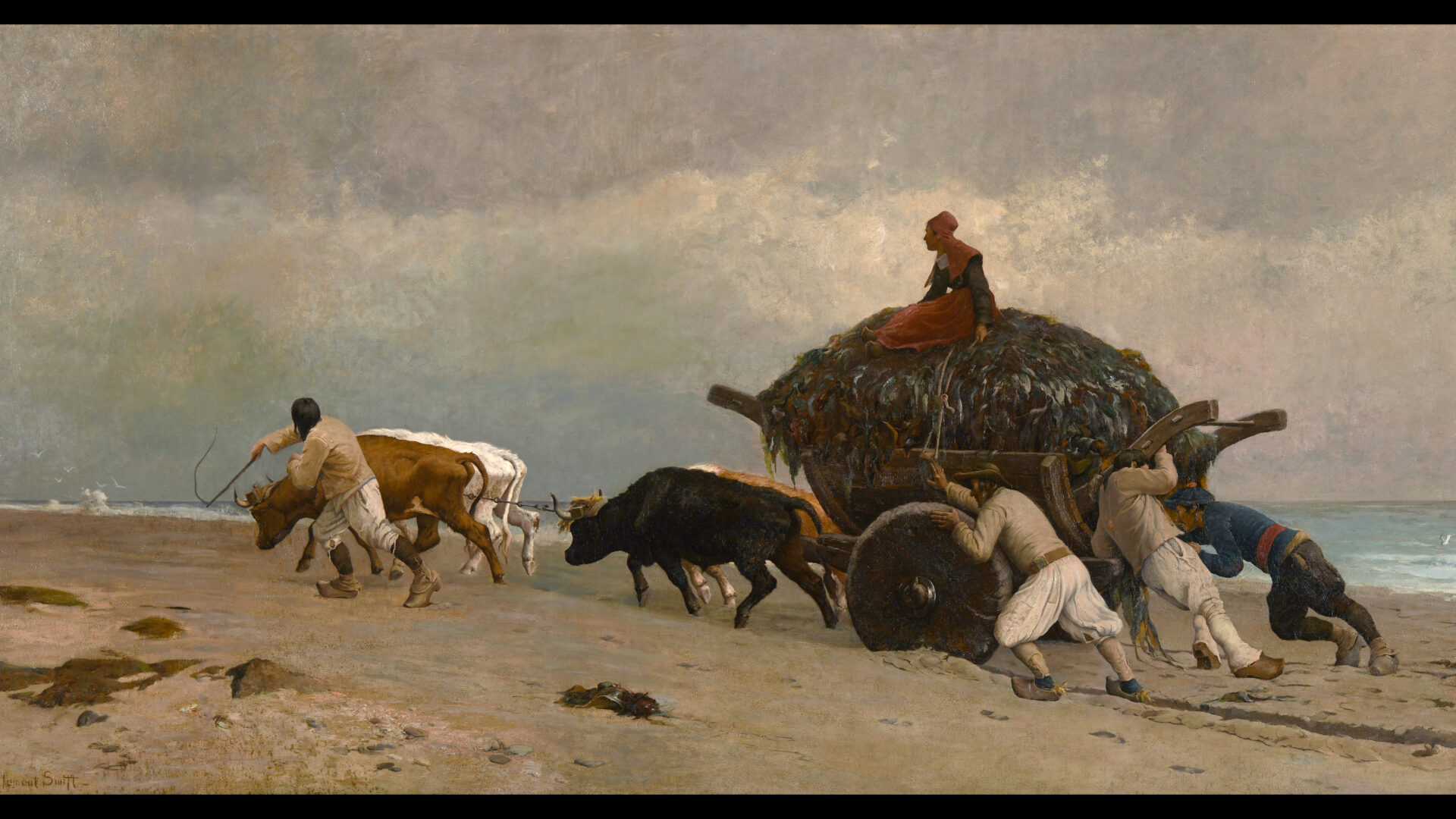
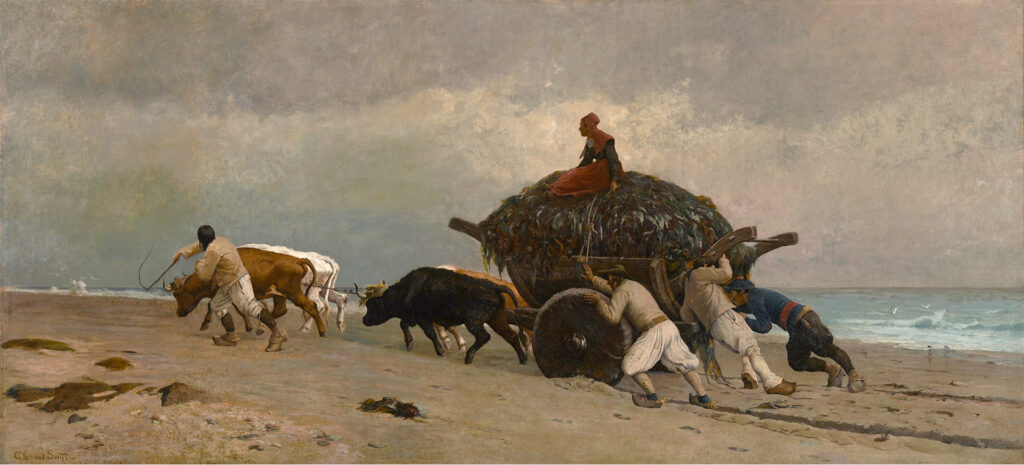
CAPTION: (above) Clement Nye Swift, Seaweed Gatherers, 1878. Oil on canvas, 41 x 93 inches, New Bedford Whaling Museum, 2015.9.1
Capturing seaweed and more with sunprints
Thursday, July 13, 2:00-3:30pm
Join the Museum as we engage hands-on-learning around seaweed and sea creatures in a fun and creative way. Families will be able to take home their own seaweed crafts!
Seaweed Roundtable: Science and Food
Thursday, August 3, 6:00-8:00pm
Roundtable discussion with experts in modern seaweed applications – including sustainable aquaculture, renewable foodways, as a biofuel alternative, and a mode of carbon sequestration – moderated by Naomi Slipp, Chief Curator, NBWM. Light reception to follow.
Seaweed Roundtable: Arts and Culture
Thursday, October 5, 6:00-8:00pm
Roundtable discussion with experts in the culture and aesthetics of seaweed – including in painting, decorative arts, literature, and visual and material culture – moderated by Naomi Slipp, Chief Curator, NBWM. Light reception to follow.
“Tide pool Exploration” excursions in partnership with Sippican Lands Trust
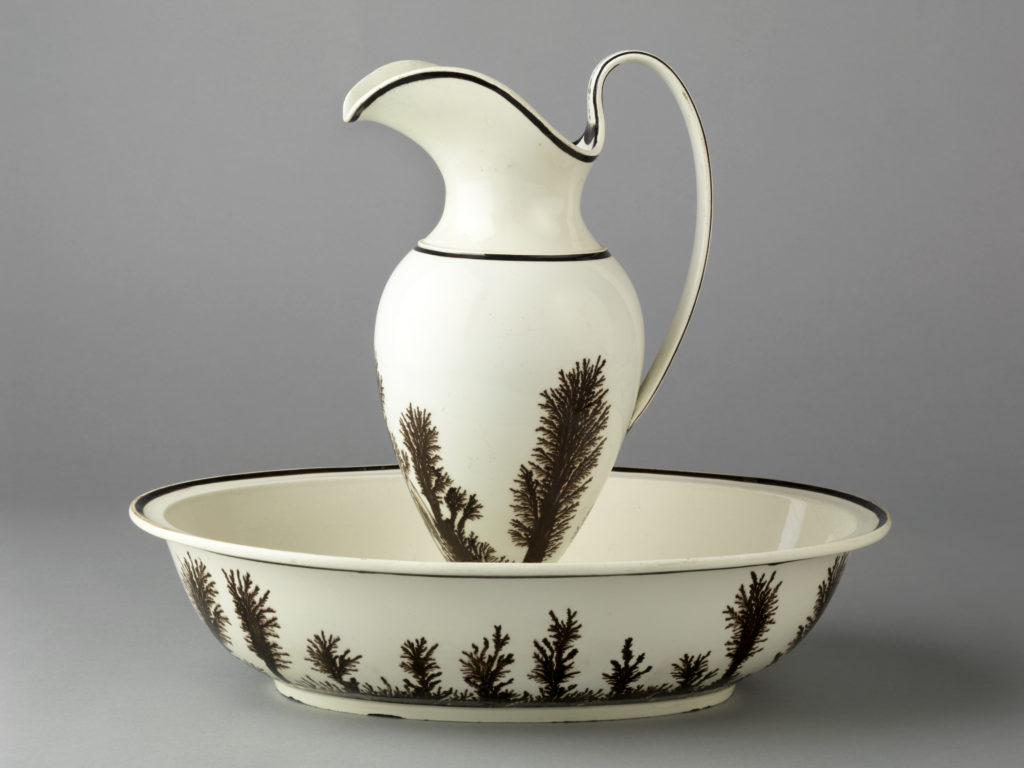
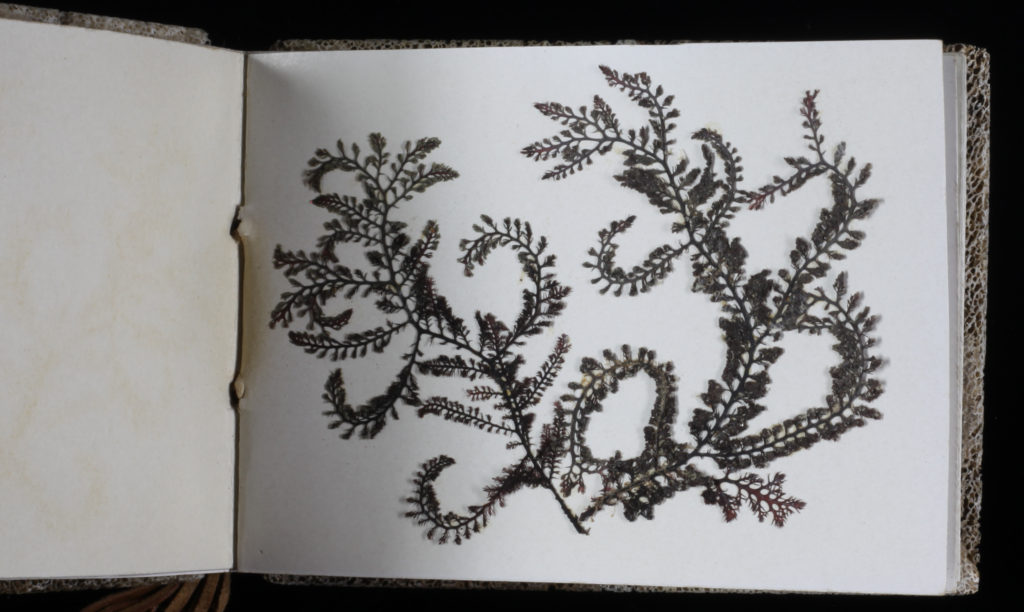
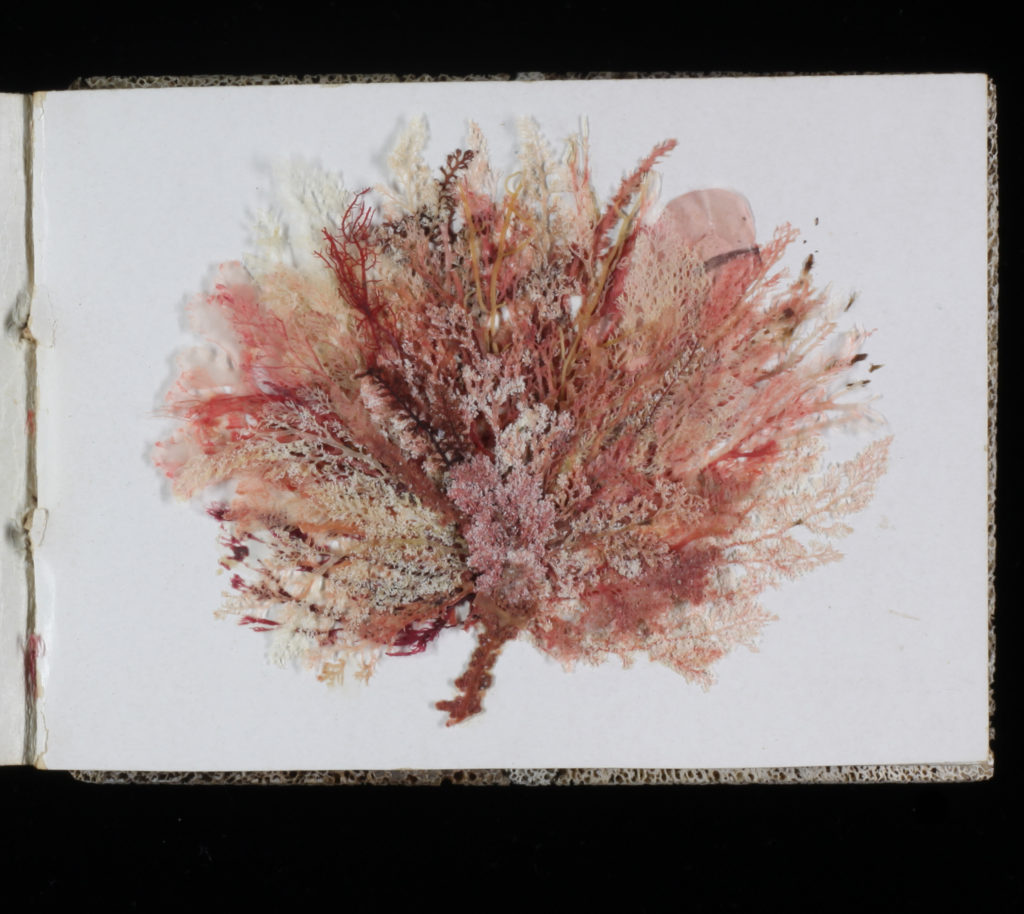
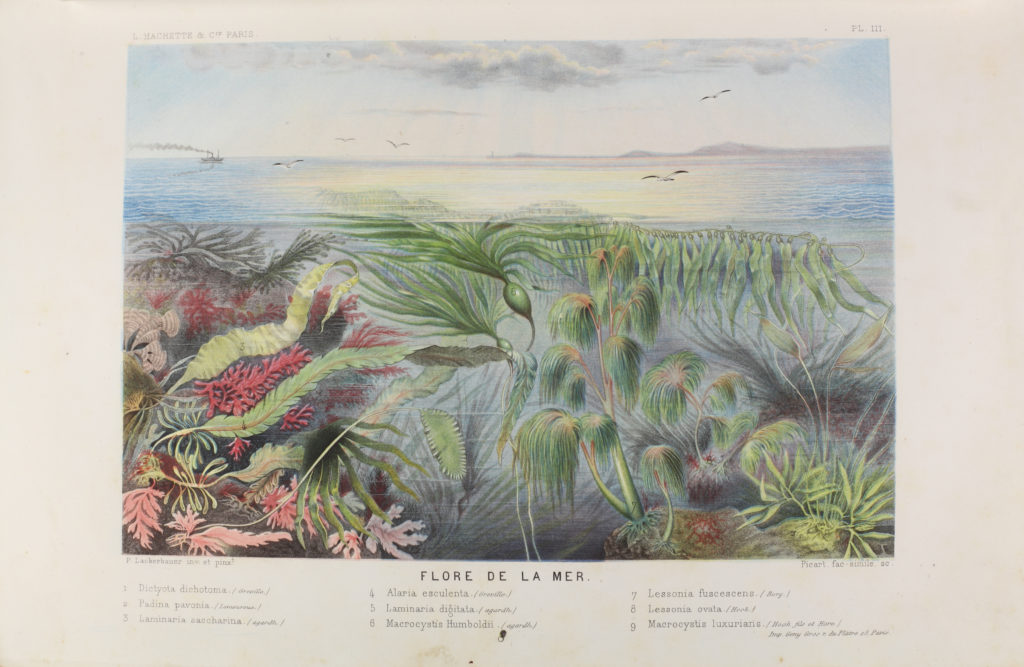
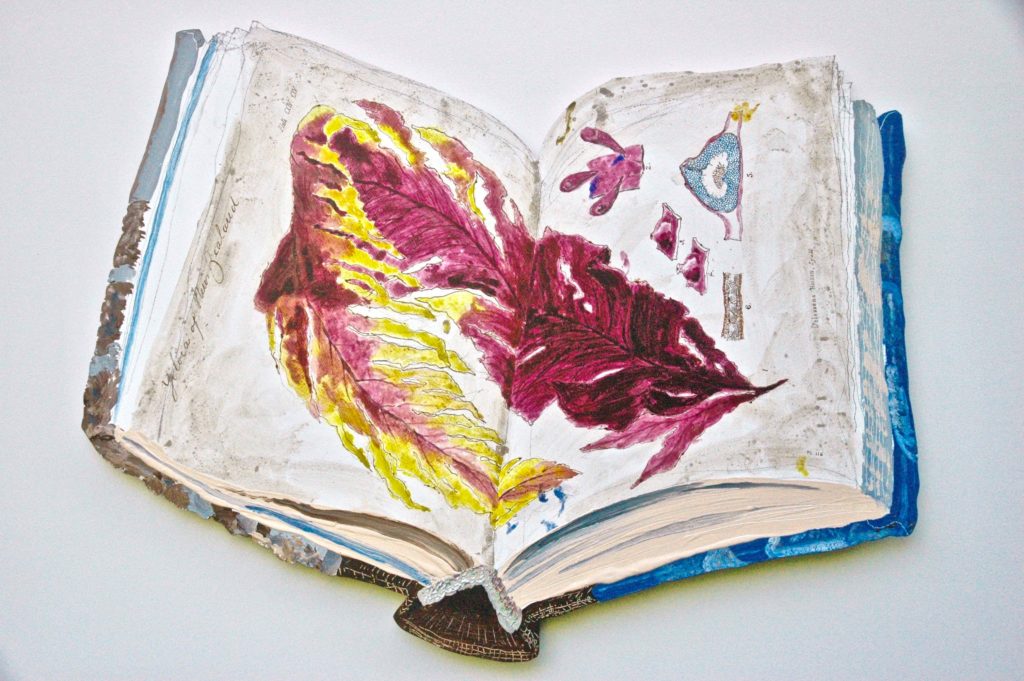
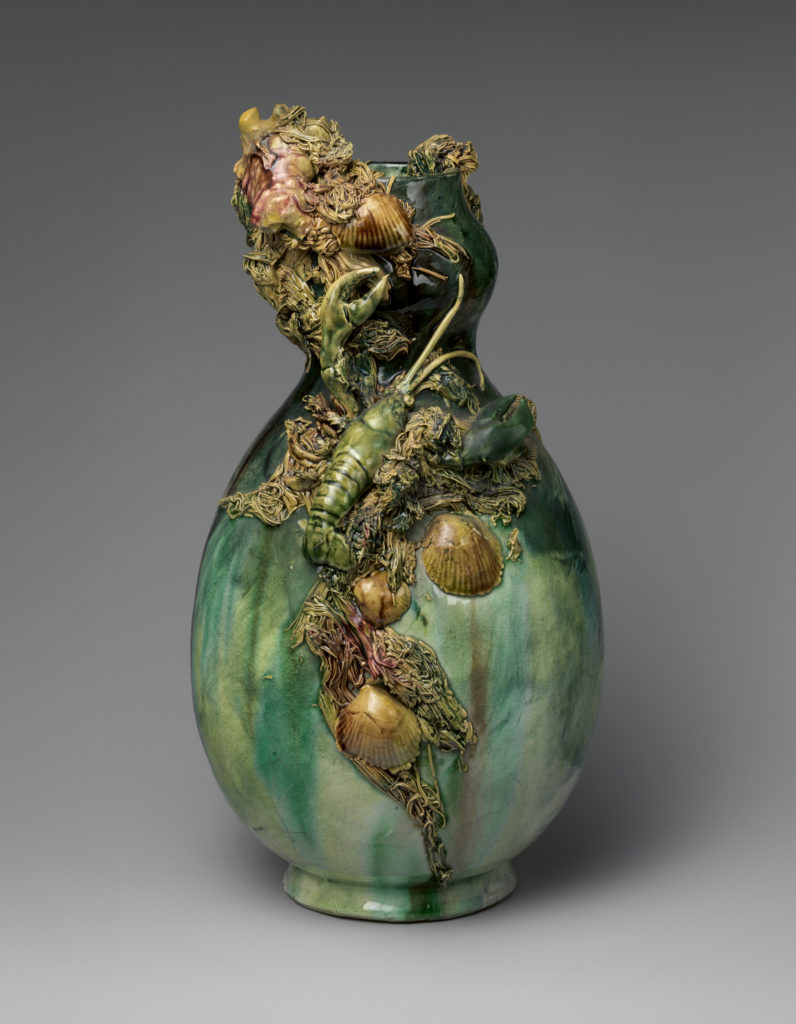
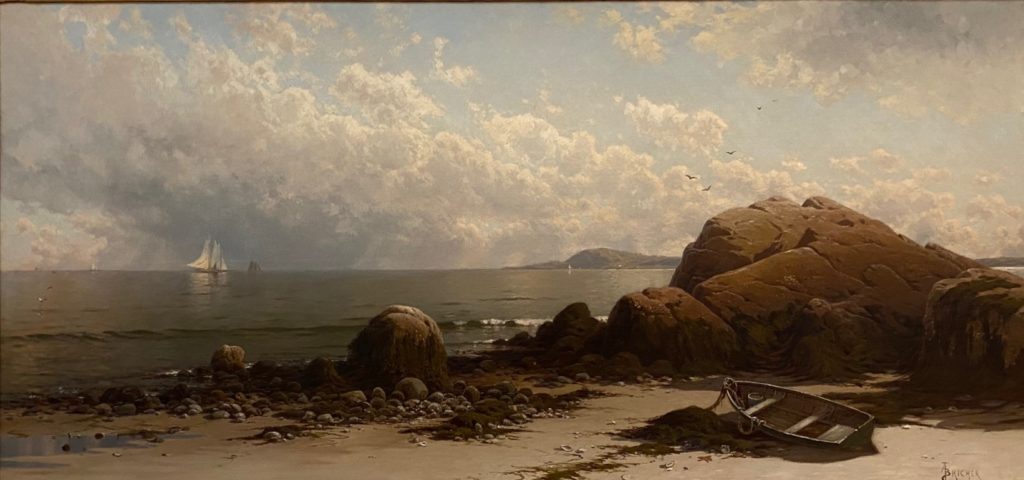
A Singularly Marine & Fabulous Produce: the Cultures of Seaweed opens to the public from June 16 – December 3, 2023 and is curated by Naomi Slipp, Douglas and Cynthia Crocker Endowed Chair for the Chief Curator, and Maura Coughlin, Northeastern University. This major exhibition of over 125 works probes humankind’s fascination with seaweed from 1780 to today, tracking changing aesthetics and modes of representation, all while underscoring a continuous and unwavering interest in seaweed as “singularly marine & fabulous,” as described by Thoreau. Art, science, and industry combine in this innovative exhibition that thinks about the past cultures of seaweed, and its applications today and into the future.
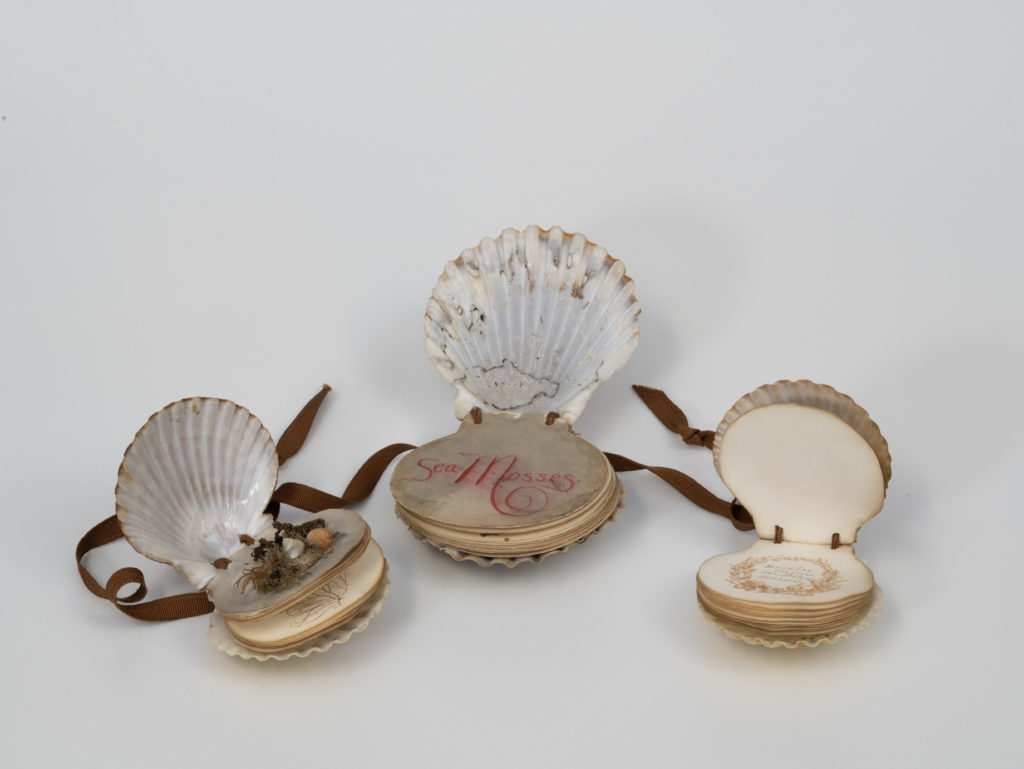
Nineteenth-century American, European, and English audiences were drawn to the myriad unique and mysterious qualities of this vegetation of the sea. Seaweed was a subject of middle-class parlor entertainments, personal gift giving practices, serious scientific study, industrial application, “making-do” working-class culture, culinary experimentation, and aesthetic examination in painting, photography, sculpture, decorative arts, and textiles. In various locations, seaweed appealed to working class laborers and farmers, and to middle and upper class collectors and scientists. It also appeared as a subject and a material in fine art, personal scrapbooks, and various shoreline industries, and is today a celebrated subject and material in contemporary art.
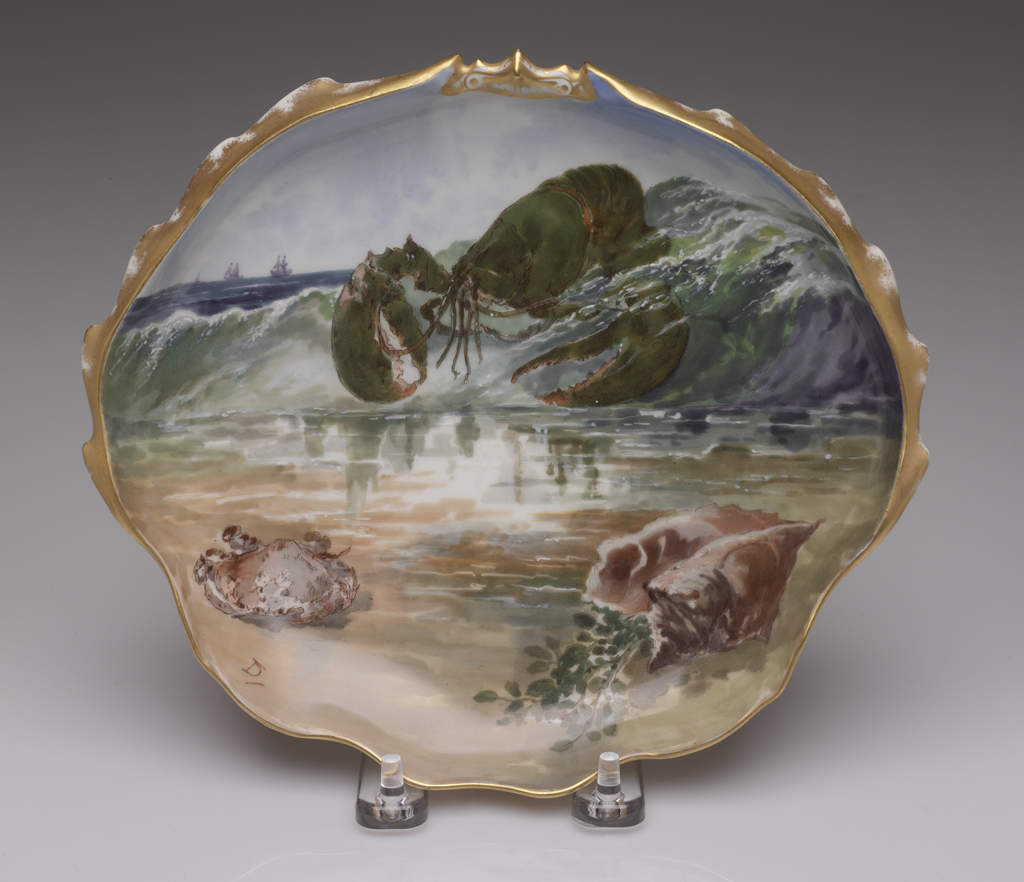
This major exhibition at the NBWM includes loans from over thirty lenders along the Eastern seaboard. Objects in the exhibit range from rarely exhibited watercolors by significant American artists John Singer Sargent and Andrew Wyeth to exuberant decorative arts – including glass, silver, and ceramics — by Pairpoint Company, Tiffany & Company, Wedgewood, Thomas J. Wheatley, Haviland/Limoges, and Georges Hoentschel – to amateur-made seaweed albums, collages, and early salt-paper and cyanotype photographs.
A 222-page hardcover scholarly catalogue includes contributions by 12 leading interdisciplinary scholars. Public programs, including scholarly roundtables, tidepool exploration workshops with local Lands Trust partners, and children’s programming, extend the exhibition themes. The programming and catalogue make connections between the cultural histories of seaweed and urgent environmental issues of today related to climate change, aquaculture, and sustainability. How was seaweed a material of interest in the past, and how is it providing critical answers to our future?
The Cultures of Seaweed exhibition, publication and public programming is made possible by major support from:
Presenting Sponsor

Susan S. Brenninkmeyer
The William M. Wood Foundation
The Wyeth Foundation for American Art
Additional Support from
Benefactors
Marnie Ross Chardon & Marc E. Chardon
Victoria & David Croll
Vineyard Wind
Patrons:
Jewelle W. & Nathaniel J. Bickford
Marilyn & David Ferkinhoff
The Nature Conservancy
Subscribers:
Cynthia & Douglas Crocker II
Gilbert L. Shapiro
Supporters:
Vanessa & John Gralton
Keith Kauppila
Frances F. Levin
Maine Coast Sea Vegetables Inc.
Maine Seaweed Council
Beth & Carmine Martignetti
Carolyn & James Rubenstein
Springtide Seaweed, LLC
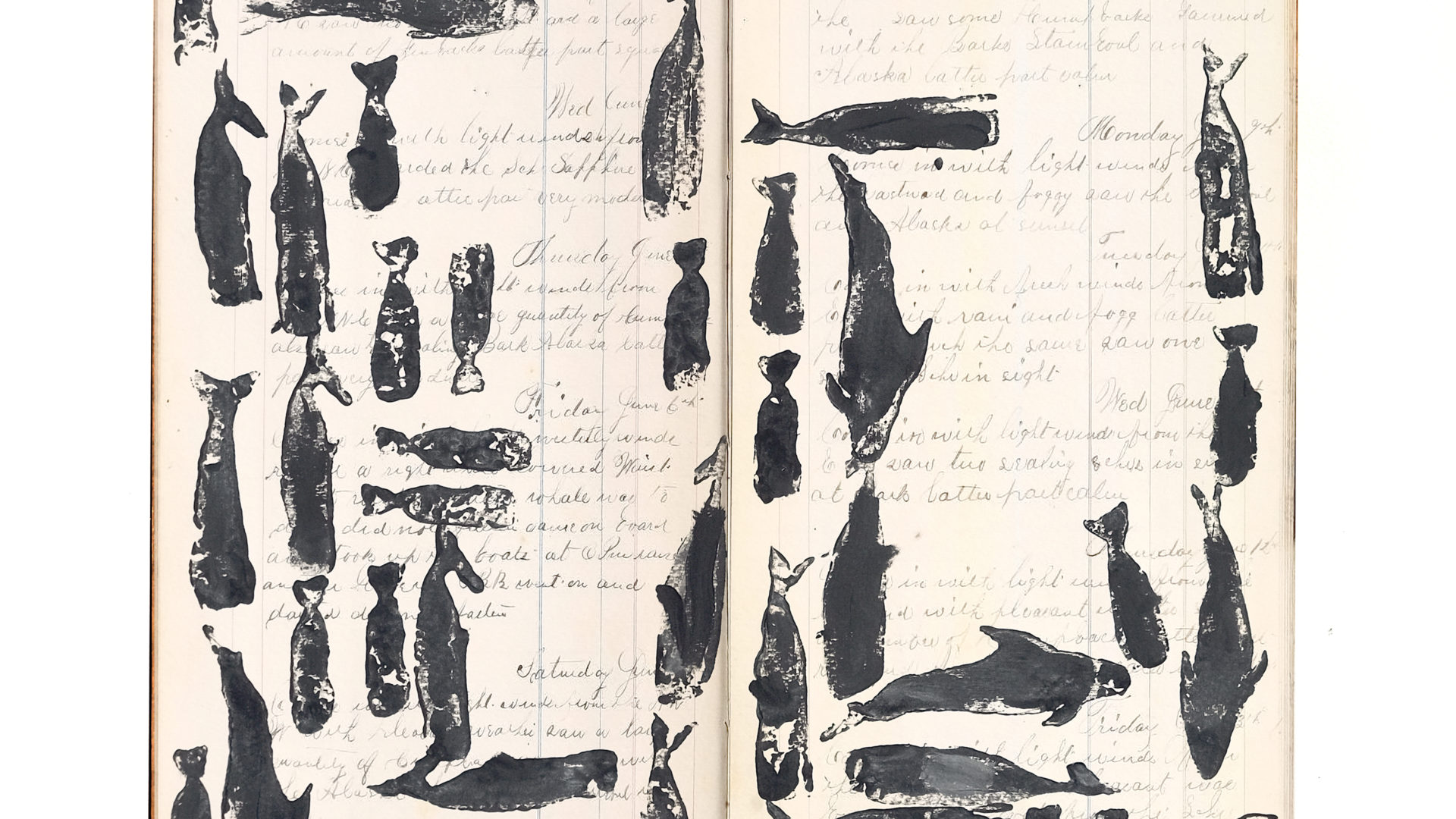
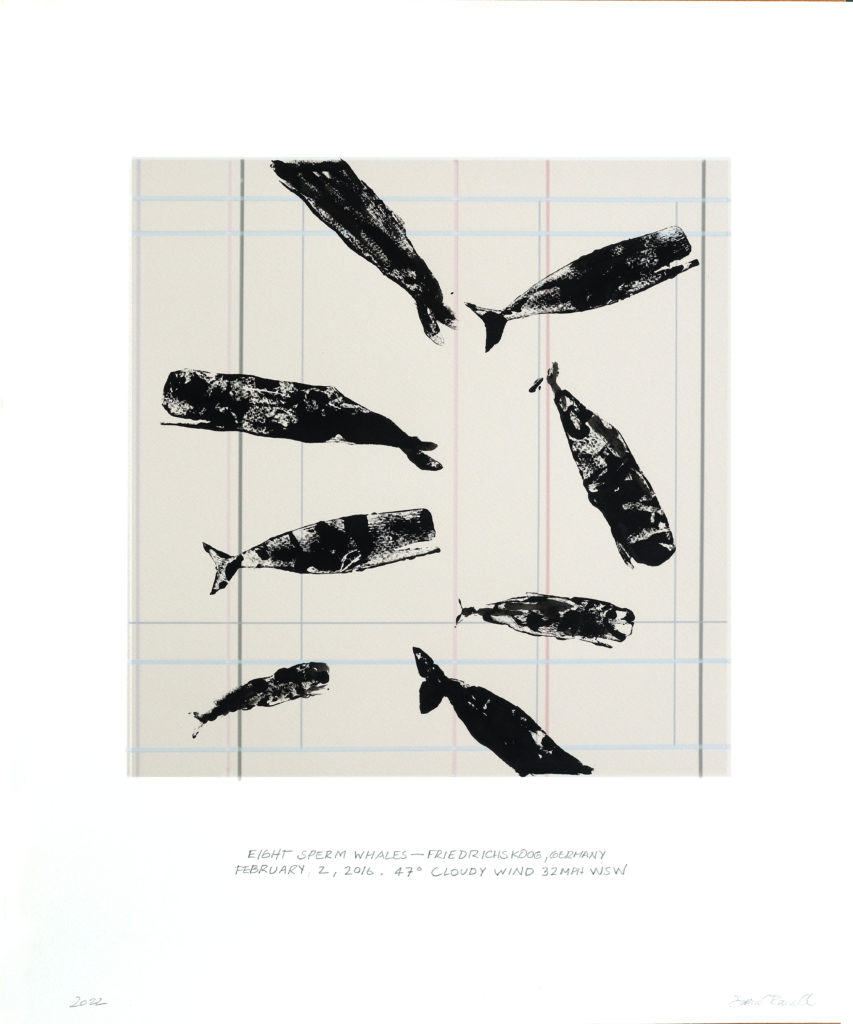
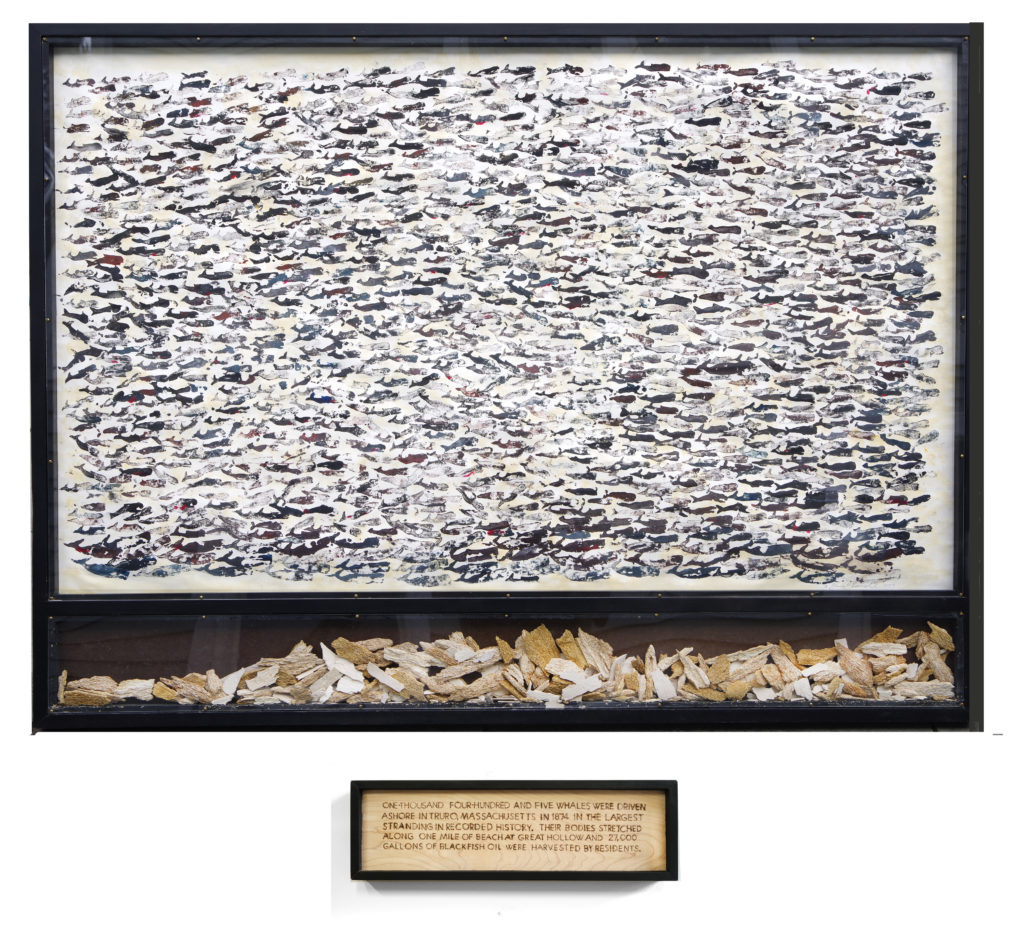
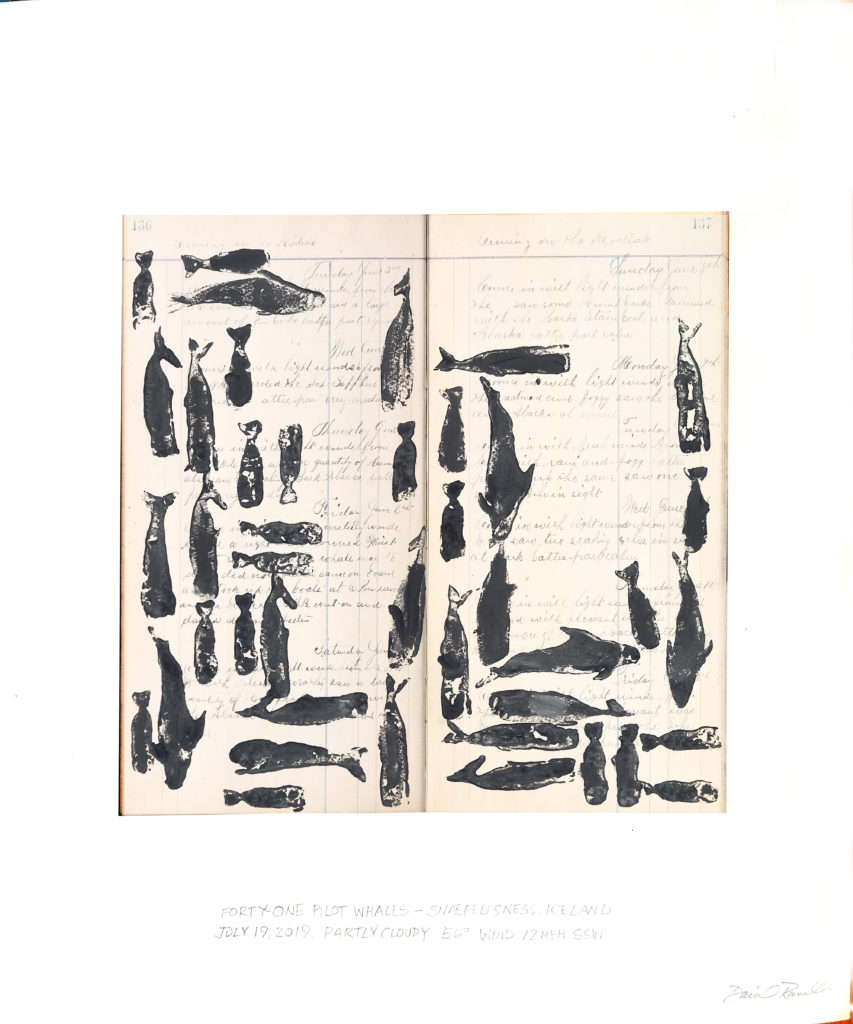
WHALE STRANDING: Daniel Ranalli
New Bedford Whaling Museum
Upper level Gallery
Opened: May 19, 2023
Closing: February 19, 2024
CAPTION: (above) Daniel Ranalli, Stranding Series: Pilot Whales, Iceland 2019, 2022. Unique Block Print on rag paper, 24 x 20 inches.
Rescue and Record: Whale Stranding as Art and Action
Wednesday, November 1, 6:00-8:00pm
Roundtable discussion with artist and printmaker Daniel Ranalli, Katie Moore, Manager of the Marine Mammal Rescue and Research, IFAW, and Naomi Slipp, Chief Curator, NBWM. Reception to follow.
Cetacean stranding, more commonly referred to as beaching, refers to the phenomenon of dolphins and whales stranding themselves on beaches. There are around 2,000 strandings each year worldwide, with most resulting in the death of the animal.
Massachusetts artist Daniel Ranalli has been fascinated by the subject of whale strandings since he observed one first hand in 1991 at Wellfleet. As Ranalli explains: “My research into the history of such strandings uncovered a historical record of strandings in both the U.S. and abroad.” For Cape Cod, the history can be traced back to the early 1600s, and certain areas – the Outer Cape in particular, has a very high incidence of strandings and “drivings” (when whales were driven ashore intentionally). Combining an interest then in marine mammal science, the environment, and whaling history, Ranalli’s project is historically rooted and timely.
Whale Stranding draws together work from this series, made over the past thirty years – including recent pieces completed for this exhibition, and sets them in conversation with items from the New Bedford Whaling Museum’s collection, including photographs and stereoviews of historic whale strandings, illustrated logbooks from whaling voyages, and original whale stamps used on those voyages. While Ranalli is most fascinated by historical strandings, he does not explicitly address the current practices for combating strandings within his body of artwork. The exhibition, however, does expand outward to share current scientific work around and approaches to strandings locally and globally.
The exhibition includes related programming and the publication of a softcover catalogue, which includes essays from artist Daniel Ranalli about the inspiration and execution of the series, Robert Rocha, Curator of Science and Research about whale strandings, Michael Dyer, Curator of Maritime History, about the visual and historical influences on Ranalli’s work, Marina Wells, Photography Curatorial Fellow, on historic imagery of whale strandings, and full color plates of Ranalli’s work from the series and images of items from the collection.
About the Artist: Daniel Ranalli has been working as a visual artist for over 45 years. His work has been included in over 150 solo and group shows, and is in the permanent collections of over thirty museums in the U.S. and abroad. The recipient of two fellowships from the National Endowment for the Arts and multiple fellowships from the Massachusetts Cultural Council, Ranalli’s work can often be characterized as conceptual and/or environmental. In 1993 Daniel Ranalli founded the Graduate Program in Arts Administration at Boston University where he taught until 2015. He lives in Cambridge and Wellfleet, Massachusetts with artist, Tabitha Vevers.
Now and Soon and Somehow Forever
Center Street Gallery
Opening: June 16, 2023
Closing: November 26, 2023
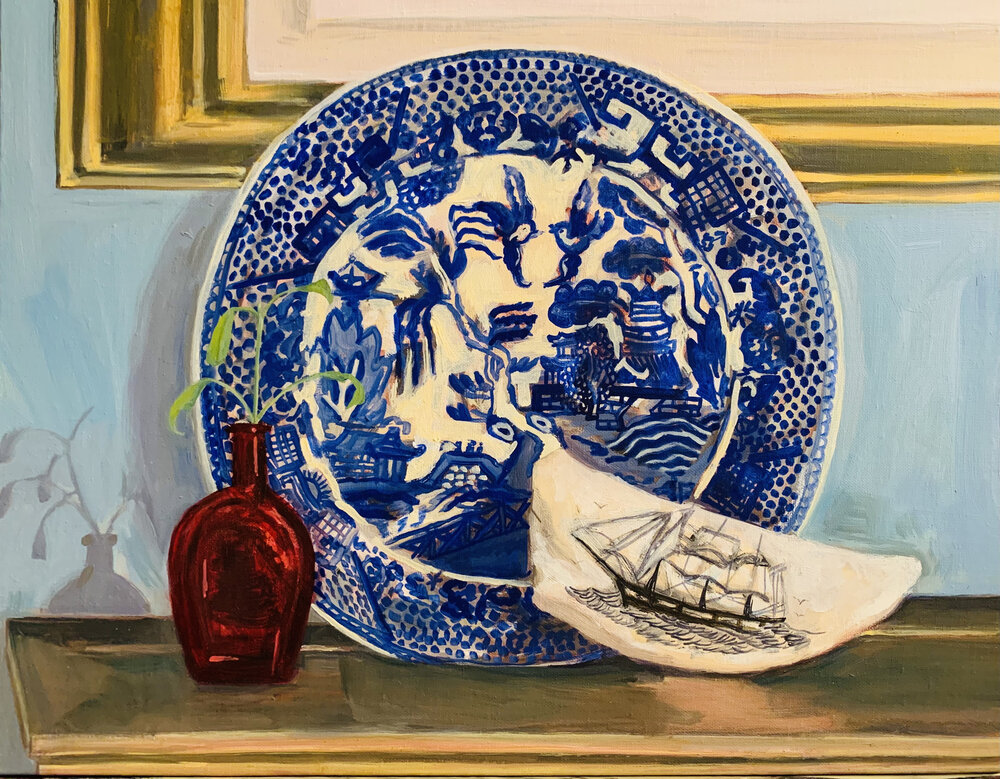
CAPTION: (above) Co-painted by William Pettit and Candice Smith Corby in Plymouth, MA, Far and Away, 1/2021. Oil on linen, 14 x 18 inches
Now and Soon and Somehow Forever: artists in conversation
Thursday, August 17, 6:00-8:00pm
Roundtable discussion between artists Candice Smith Corby and William Pettit, with Naomi Slipp, Chief Curator, NBWM. Reception to follow.
Now and Soon and Somehow Forever, co-created by artists William Pettit and Candice Smith Corby, represents a significant creative endeavor and a transatlantic creative process of exchange, adaptation, and generation. The project gestures to the past, while also being firmly rooted in attempts to understand our present condition and experiences.
Steeped in the histories of global whaling and deeply tied to the objects in the Museum collection, Pettit and Corby poetically engage with Museum artworks, objects, and archives. The two forge tangible connections between past and present through processes of making and adaptation, in order to underscore the global interconnectedness of people and things. Intermingling truth and fiction with romantic nostalgia of a time gone by and at once still present, the works include messages in bottles, handmade artist materials replicating historic traditions, love knots, and paintings of sea-related themes – including painted replicas of Museum works.
The exhibition transports visitors across vast distances and spans epochs – both short in duration and centuries in scope. Ultimately, the project connects the desires and longing of nineteenth-century maritime travel, letter writing, and ship-board voyaging with the kinds of translocations and physical separations created by the COVID-19 pandemic and concomitant global shut-down. What domestic intimacies were created, exchanged, lost, or disrupted by the 3-5 year long whaling voyages? How did objects and letters materially telegraph desire, longing, and memory? In the most apt way, how did scrimshaw, shell wreaths, and other shipboard and domestic handicrafts operate as literal souvenirs (French for “to remember”) during their creation and, later, reception?
In what ways, might these experiences and objects – made 200 years ago – parallel or stand-in for the kinds of distances, missed connections, and melancholy of the current pandemic?
Joining this impactful installation are cases of objects and select paintings from the Museum’s collection, which provided inspiration for the two artists, including shell wreaths, scrimshaw, marine scenes, sailor’s knots, and other domestic and maritime handicrafts. These works operate as companions to their contemporary parallels; a sort of call and response or echo between old and new; original and artful facsimile.
About the Artists: Candice Smith Corby is an artist, and Professor and the Director of the Carol Calo Gallery in the Visual and Performing Arts Department at Stonehill College near Boston, MA. She is interested in connecting contemporary image-making with historical methods and materials. She is a Massachusetts Cultural Council 2008 Fellow and 2014 Finalist in painting, a 2011 Dave Bown Project Grantee, and received a 2013 Awesome Foundation grant. She was the invited 2018-19 Guest Artist at Fruitlands Museum in Harvard, MA which included an artist book and solo exhibition “Inhabiting Folk Portraits.” William A. Pettit III is an artist and professor at John Cabot University and Temple University in Rome, Italy. He works with ancient and contemporary painting media, as well as video and sound. Resident in the Sabina area since 1997, he has exhibited in Philadelphia, Paris, Rome, Assisi, Spoleto, Tuscania, and Gubbio.
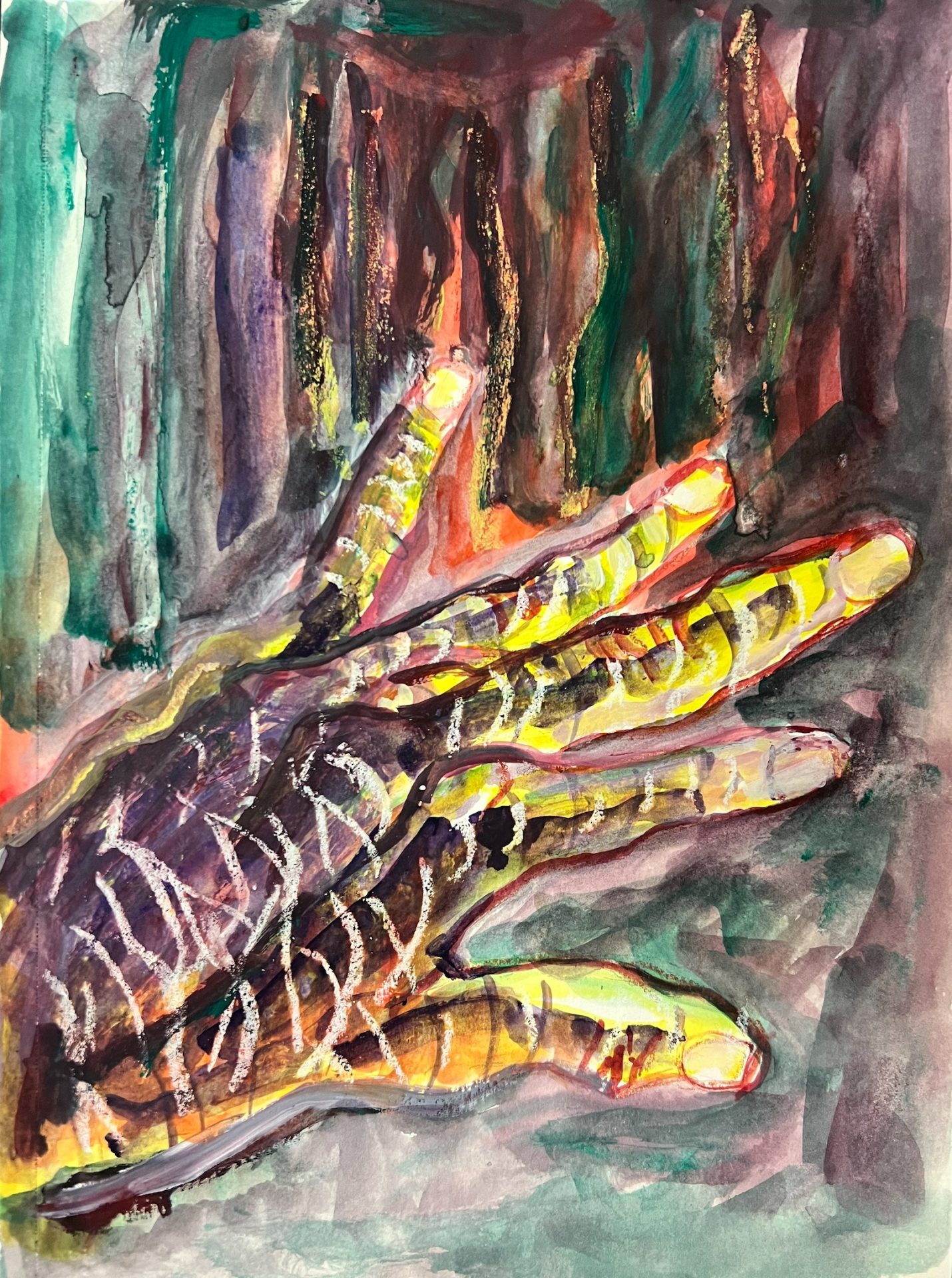
MOBY DICK IN DAYS OF PESTILENCE AND CHAOS
Observation Deck Gallery
Opening: December 22, 2022
Closing: February 26, 2023
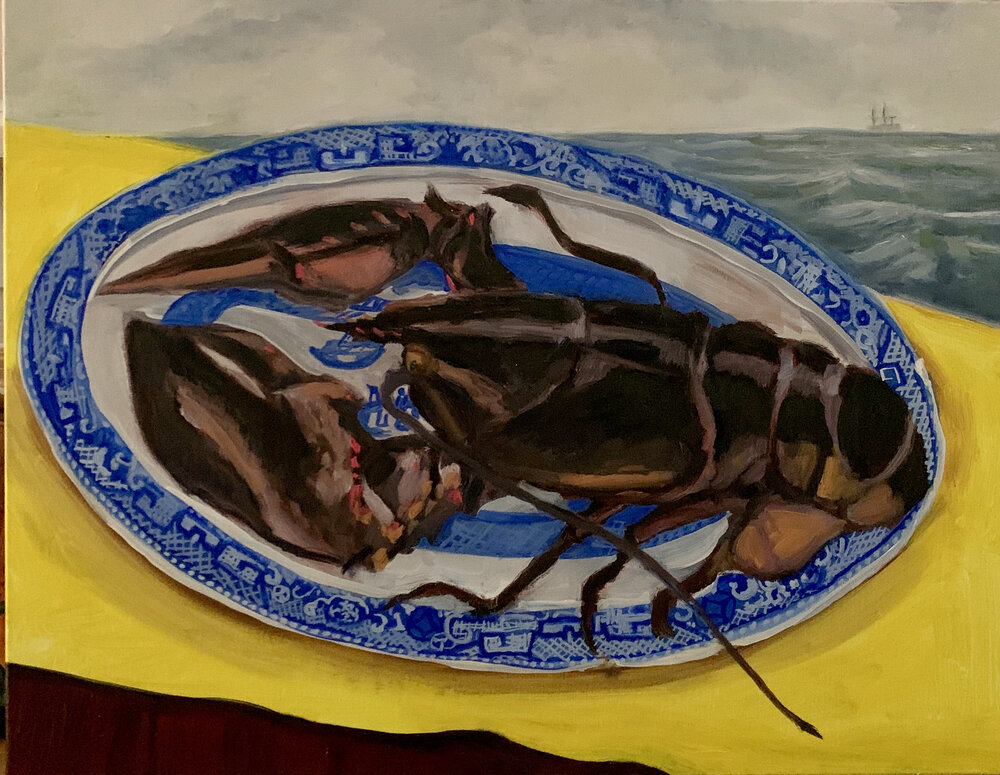
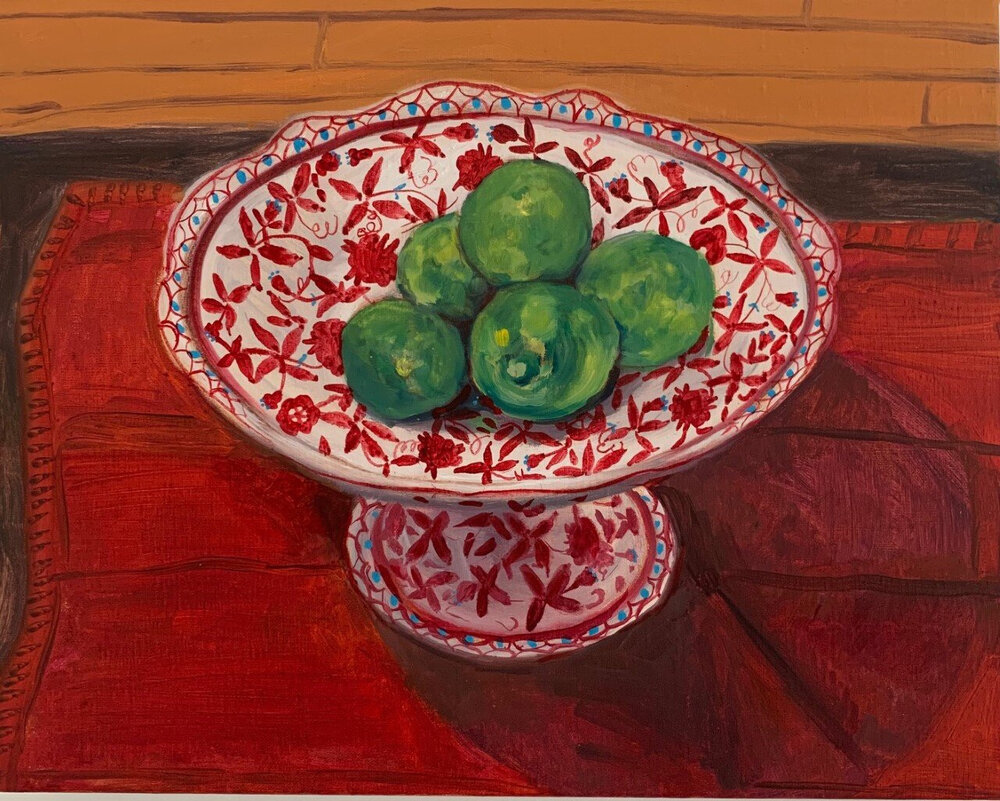
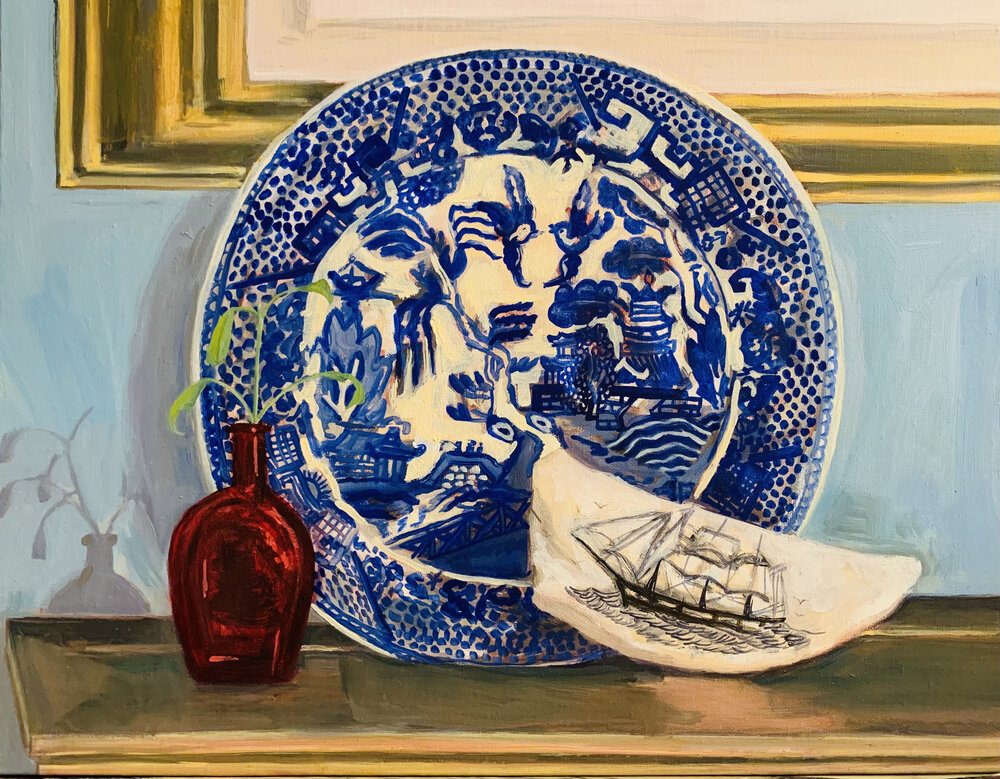
CAPTION: (above) Aileen Callahan, Contagion XLII Callahan, 2020.
In response to the COVID-19 pandemic, and working through the 2020 lockdown, Boston-based artist Aileen Callahan (b. 1941) created Moby Dick in Days of Pestilence and Chaos. This body of work explores themes of contagion and plague, and the known, the unseen, and the feared, as described by author Herman Melville (1819-1891) in the novel Moby-Dick (1851). How much time must pass before infection and chaos take hold—of a crew? —of a society? – and how do such questions apply to today?
In the 1700s and 1800s, ships entering port with sickness onboard – dubbed “Famine ships” being “foul and infected with any malignant or contagious disease” – had to quarantine for up to 40 days, passengers and crew were examined and isolated, and the vessel was thoroughly fumigated. Such vessels raised a ‘yellow flag” during the day and shone a light at night until it was safe to enter the port. In 1848 at Mahon, Spain, traveler Edwin Monague recorded how, “The abominable yellow flag, still marks our ship as ‘plague smitten.’ Every boat steers off from us afraid of contamination.” This “fear of contamination” is the focus of “The Jerobaum Story,” Chapter 71 of Moby-Dick.
When writing Moby-Dick, Melville was very aware of the dangers of plague and disease, especially at sea. He describes Elijah, a character “whose face bears the gruesome marks of contagion” in Chapter 19. But, it is the Jerobaum arrival that truly captures the terror of illness on ship. The crew learn of “a malignant epidemic on board” the Jerobaum that makes the captain “fearful of infecting the Pequod’s company.” The chapter is filled with prophecy, doom, and portent, with shipboard plague as a backdrop.
Callahan created this series of seventy watercolors derived from the theme of contamination and pestilence in “The Jerobaum Story.” She presents abstract images of plague close-up and as washing over and inside of the titular antagonist, Moby Dick, a great white whale. The material Callahan chooses – watercolor – does physical and metaphorical work in this series. Both water and illness “spread” and lack formalized bounds. Liquid watercolor washes in varied colors and shades of light and dark create backgrounds that convey the feeling and movement of the sea, its swells and fluidity. These backgrounds “hold” the enigma of illness in the foreground, symbolized by networks of contagion that dissolve at the edges, spiral outward, and extend threatening tendrils.
The images aim to engage histories of shipboard pestilence as referents in Moby- Dick, but also connect to today, where we find ourselves engulfed within an active and ongoing pandemic. The angles, swirls, and colors present the reality of pandemic, which shifts month to month, defines our physical and spatial movement, impacts personal and public health, and threatens everyday lives.
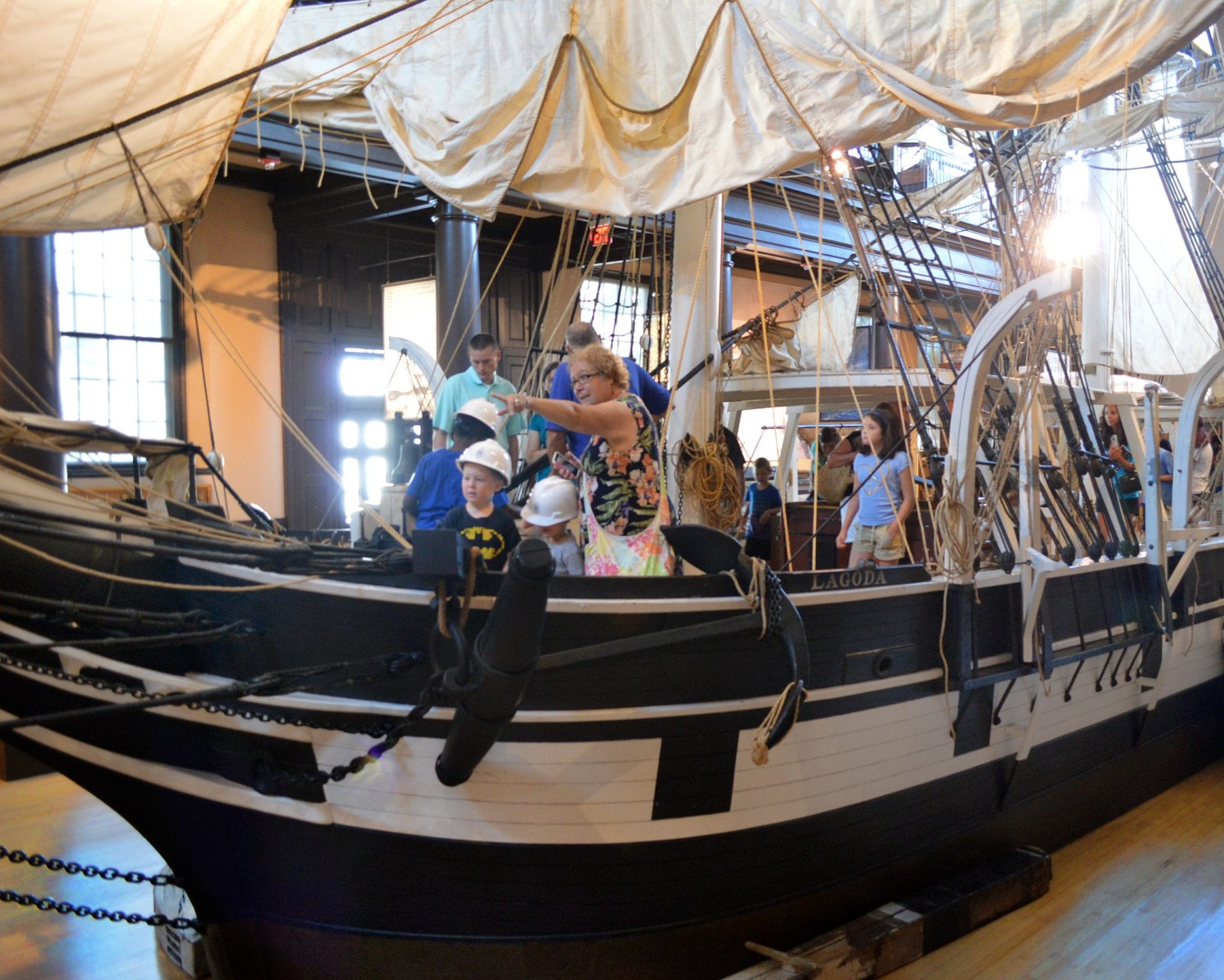
Lagoda
Bourne Building
Opened: November 23, 1916
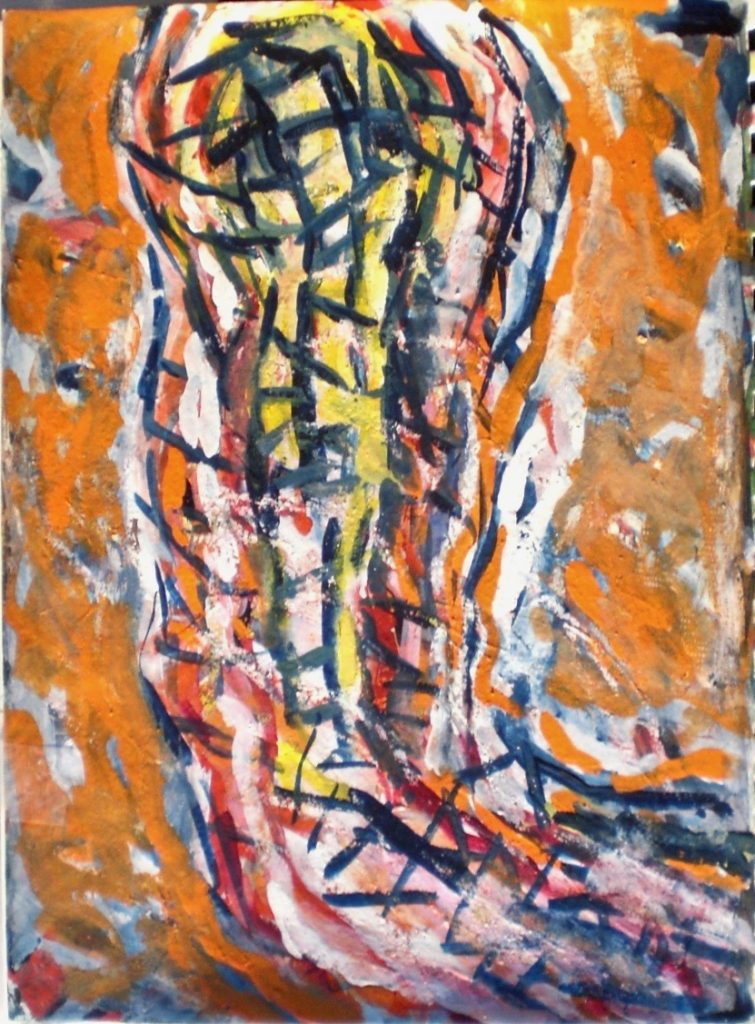
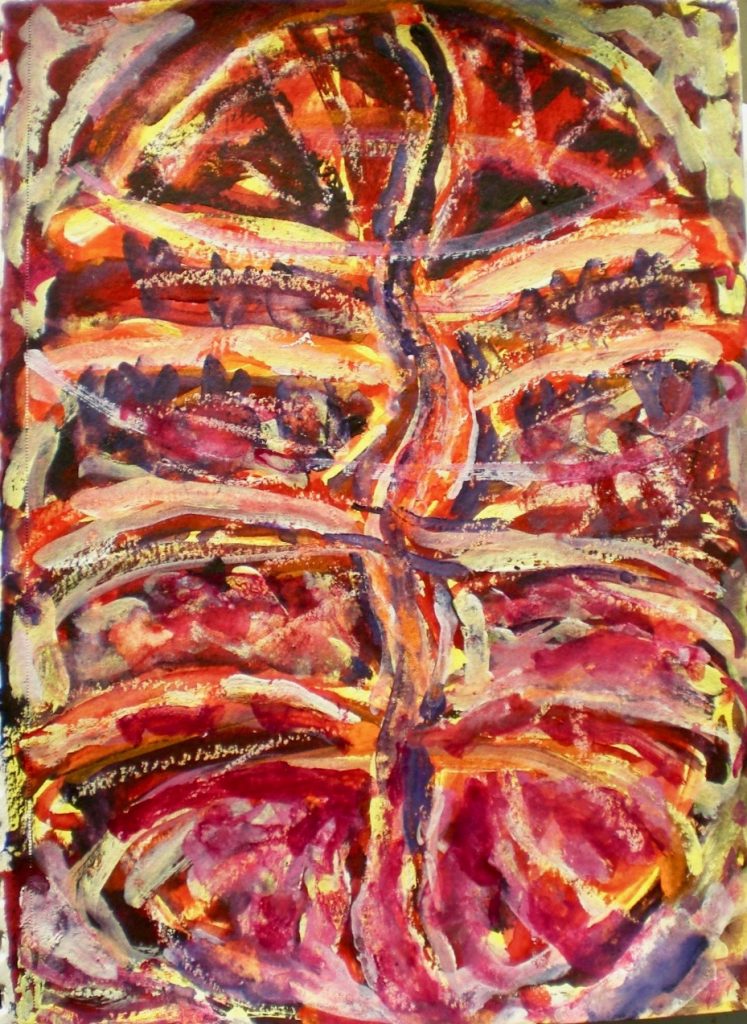
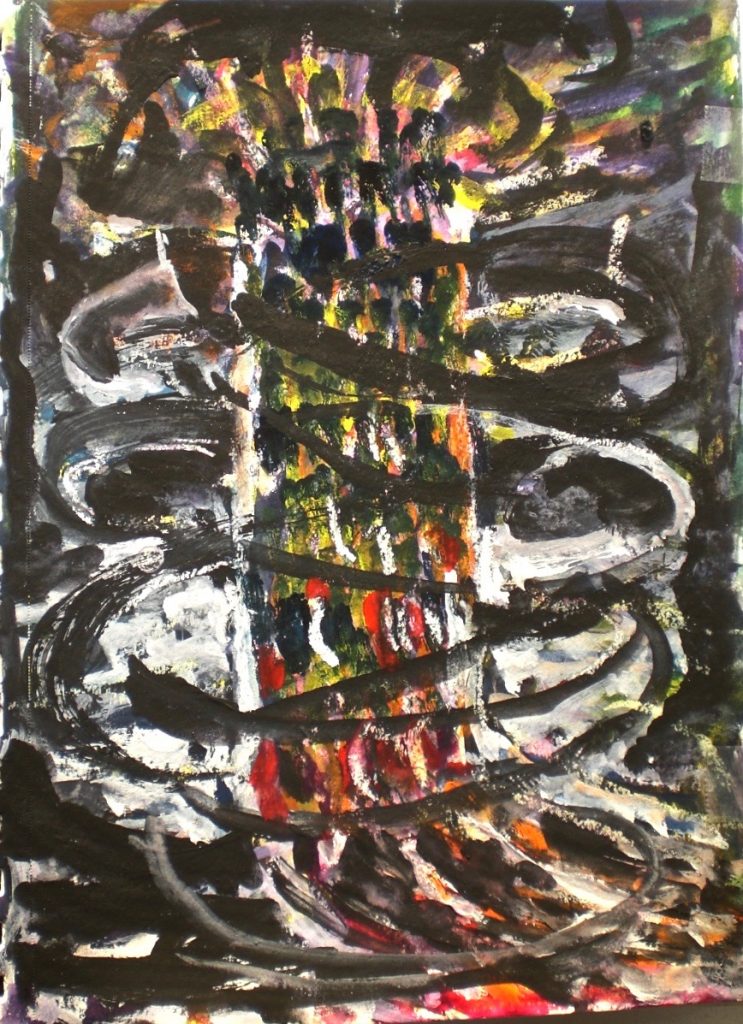
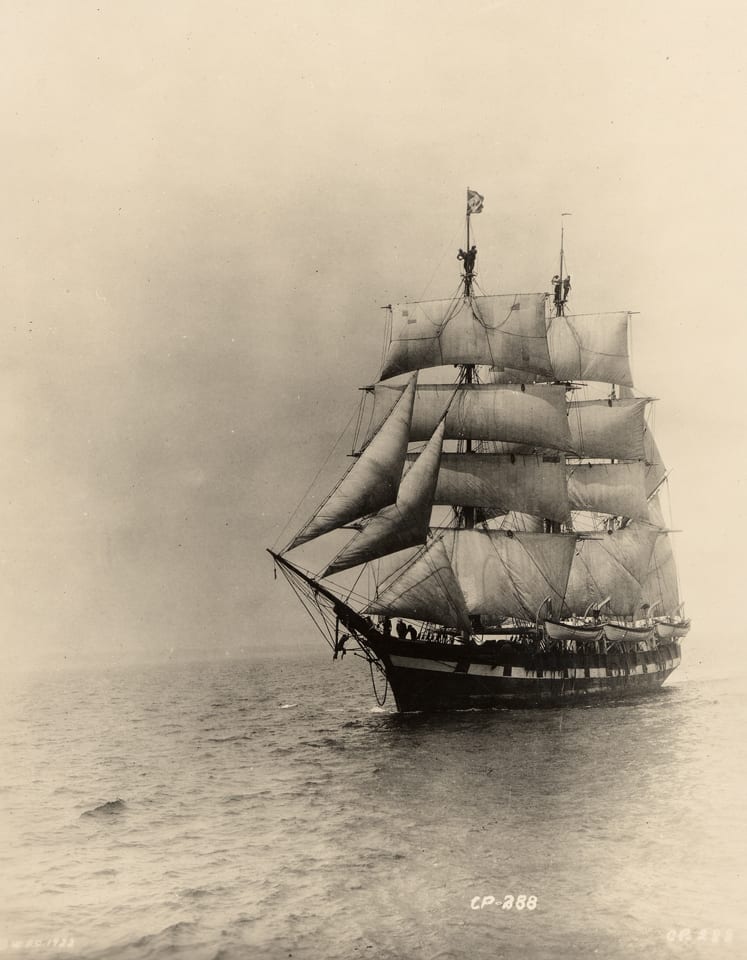
Step aboard the spectacular Lagoda, the New Bedford Whaling Museum’s half-scale model of the whaling bark. Built inside the Bourne Building in 1915-16, with funds donated by Emily Bourne in memory of her father, whaling merchant Jonathan Bourne, Jr., Lagoda is the largest ship model in existence.
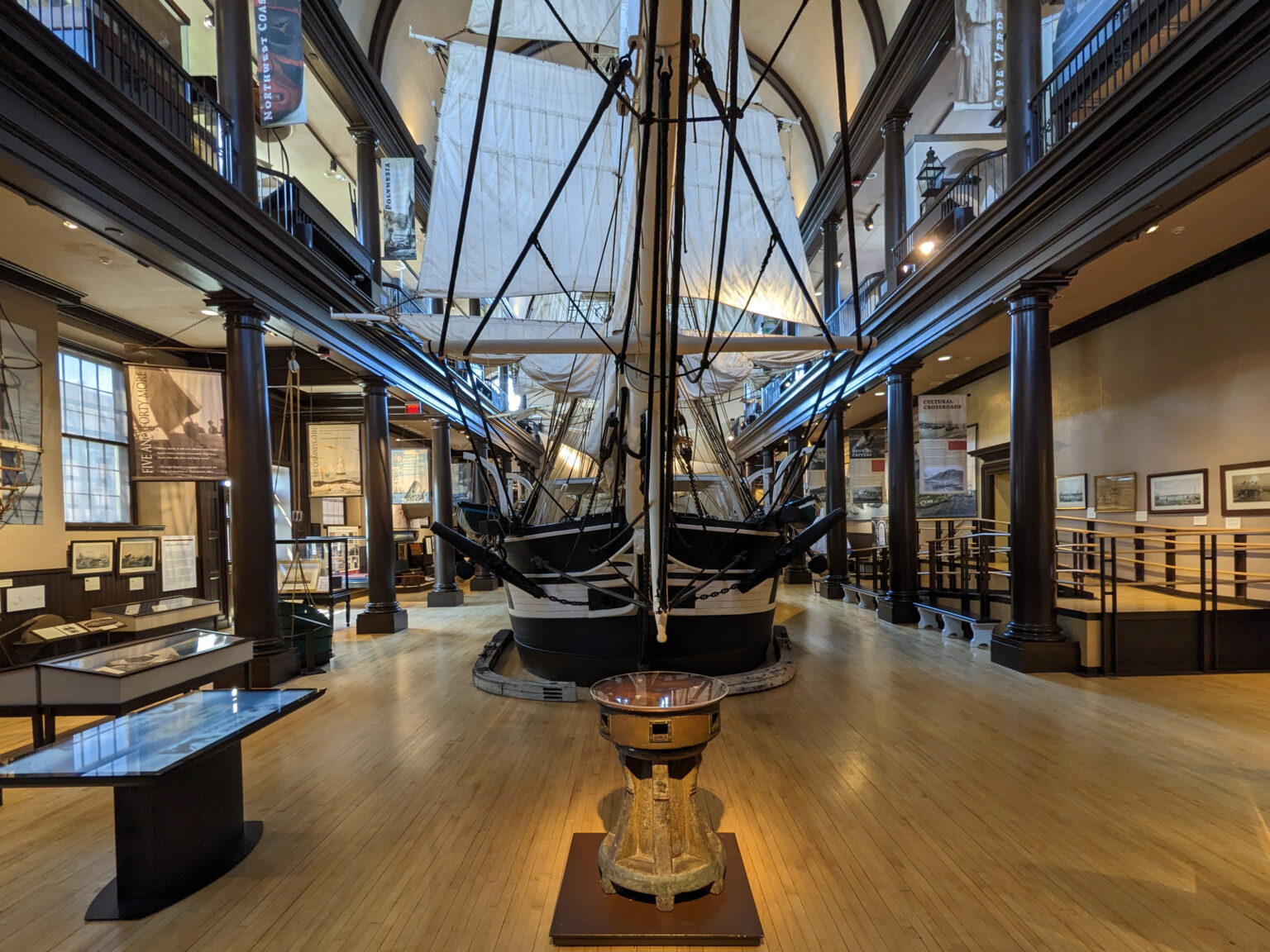
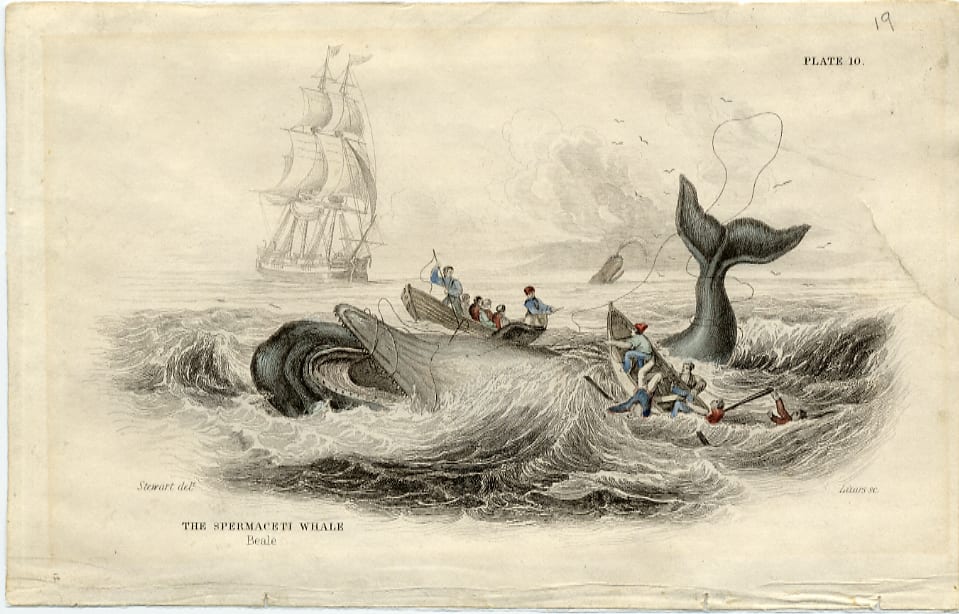
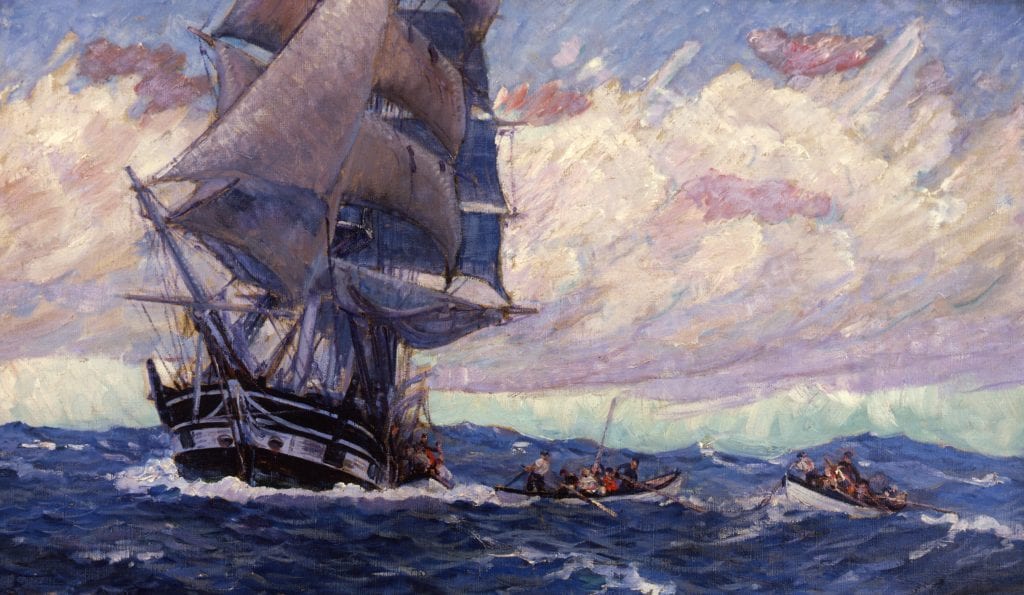
Explore the gallery to learn about the business of whaling, crew, and life on shipboard. Whaling had periods of excitement upon which this mystique has formed. Processing the blubber of a single whale took one to three days. Cutting spades, blubber hooks, boarding and mincing knives, pikes, trypots, bailers, strainers, and casks illustrate the different jobs assigned onboard once a whale was caught. When the hold contained enough full casks of oil the Captain would declare that the vessel had “made a voyage,” and it was time to return to home port. The cargo was off-loaded, tested and graded, and sold. Drawing from the Museum’s immense and unique collections of artifacts and documents, the surrounding exhibitions demonstrate the thrills and dangers of going to sea to do battle with the world’s largest animals.
So you want to “Go a whalin’” do you? Learn what it was really all about.
Voyage around the World
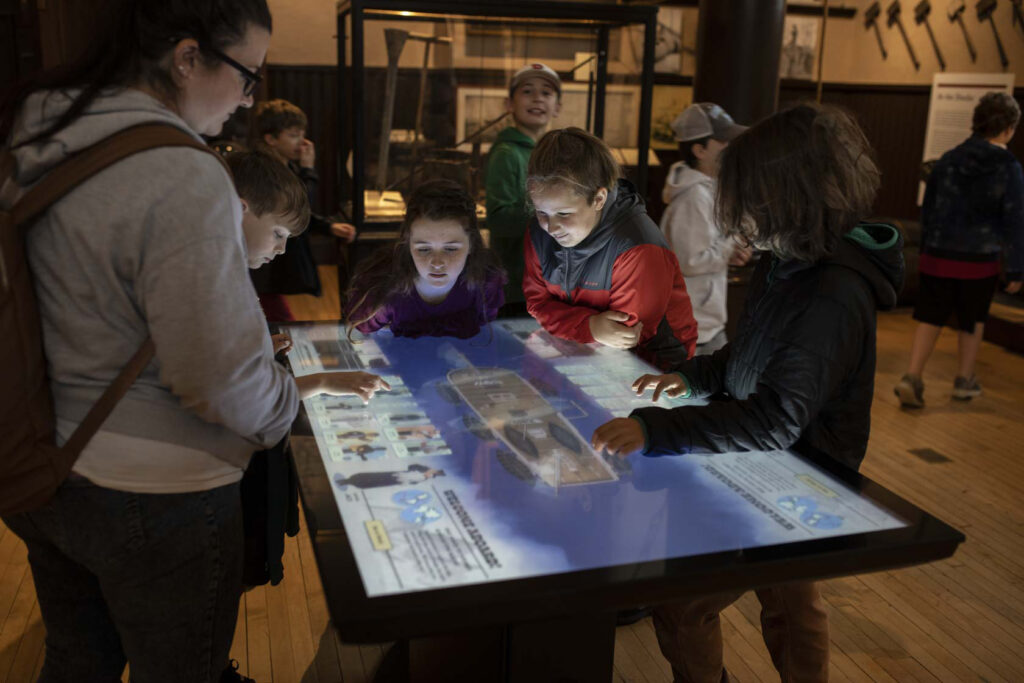
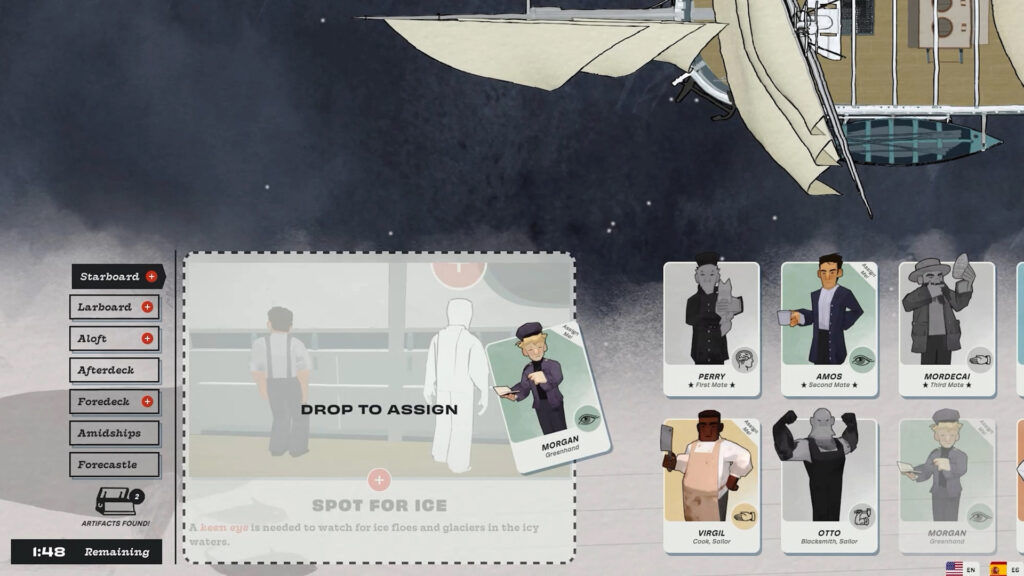
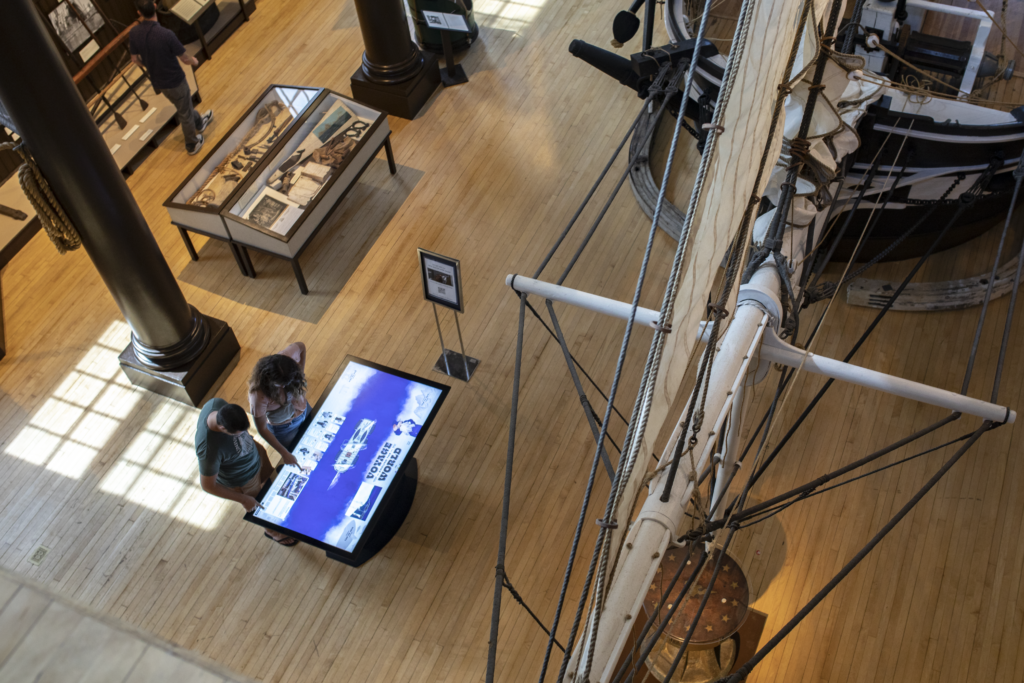
Enjoy our multiplayer interactive: "Voyage Around the World" – a multiplayer gallery game that charges visitors with managing the crew aboard a 19th Century whaleship. Explore treacherous waters, encounter whales, and uncover artifacts. Make important decisions that shape your journey and learn about whaling.
Up to four players collaborate in this touchtable game, working together to complete 15 sailing challenges. Players delve into the crews’ pastimes and backstories as they learn how to best assign them to the tasks on board. Players must share the crew, leading to cooperation, competition, and strategic discussions at the table.
The crew makeup highlights the international nature of the Yankee Whaling industry, featuring characters from all corners of the map. Whether sailing for fortune, freedom, or family back home, the crew have unique motivations for joining the voyage. Each character possesses a skill that aids in certain tasks, such as spotting whales or hauling heavy equipment.
Please participate in our user survey, tell us about your experience. Set sail and have fun on this unique adventure!
Grand Panorama of a Whaling Voyage 'Round the World
Finally, explore how every-day Americans learned about whales and whaling through popular entertainment, traveling exhibits, worlds fairs, and visual culture. Sit in the small theater and watch the digital projection of our 1,275-foot-long panorama painted by Benjamin Russell and Caleb Purrington in 1848. The Grand Panorama of a Whaling Voyage 'Round the World illustrates what Benjamin Russell and other whalers saw as they left the port of New Bedford and traveled the world in search of whales.
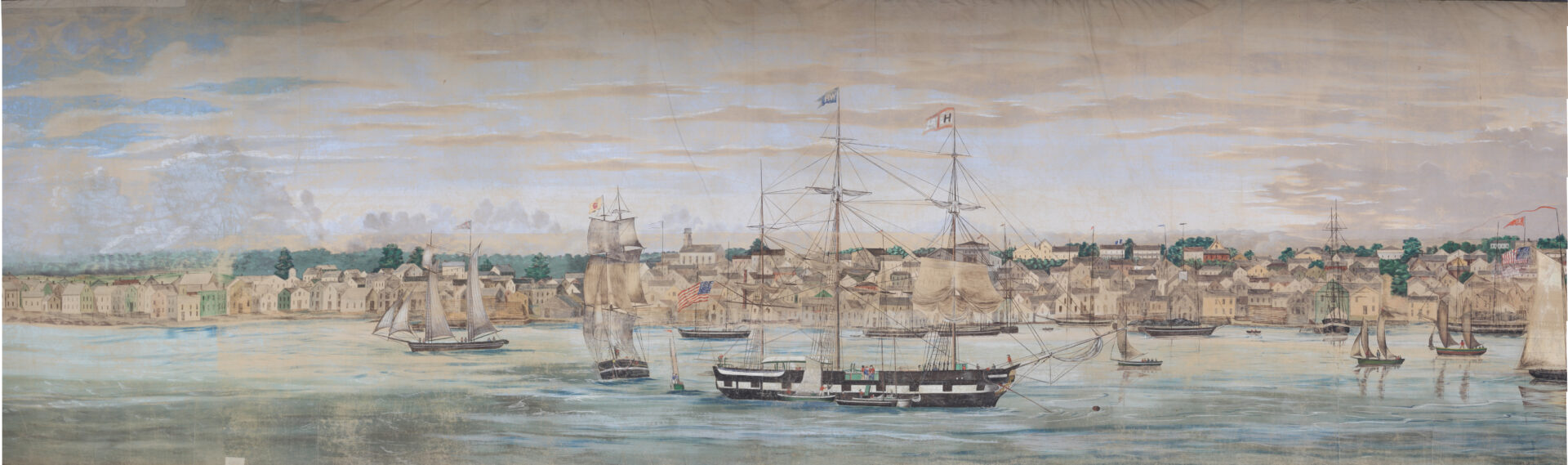
Explore the digital version of The Grand Panorama of a Whaling Voyage 'Round the World with expanded access to the history and narratives of Purrington and Russell’s Grand Panorama.
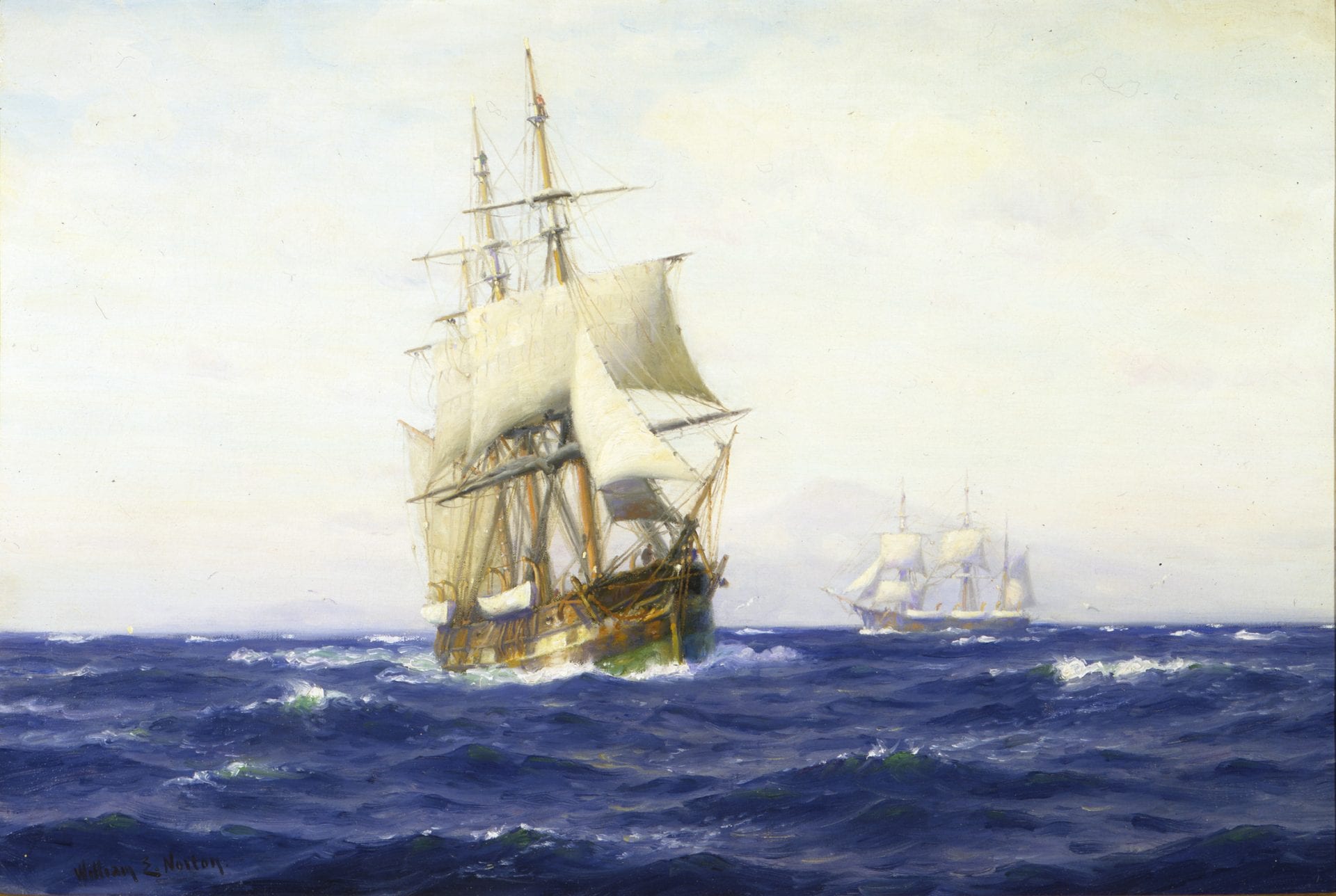
A Voyage Around the World
Opened: June 23, 2012
Grab your passport and experience a new world encountered by New Bedford whalers. Voyages connected world cultures through commerce and helped establish American hegemony in far-flung ports. Through both commercial activity and crewmen enlisting and disembarking, these voyages set in place the initial pattern of immigration that follows to this day.
Most voyages first reached the Atlantic Islands of the Azores and Cape Verde, where captains fully outfitted with supplies and crew for the long voyage ahead. This strategy made the Portuguese influence of these voyages and their cultural dissemination quite strong. Whaling literally took these men around the world, across all oceans, even to the polar extremes of the globe.
The cultural exchanges and connections made through these voyages of commerce left evidence still visible today not only in the large Portuguese and Cape Verdean communities in New Bedford but in communities on the opposite side of the country where whaling was once an important industry. The fact that California and Hawaii have significant populations of Portuguese is rooted in whaling, and the exhibit explores the Portuguese communities that remain an important legacy of the Luso-American whaling experience.
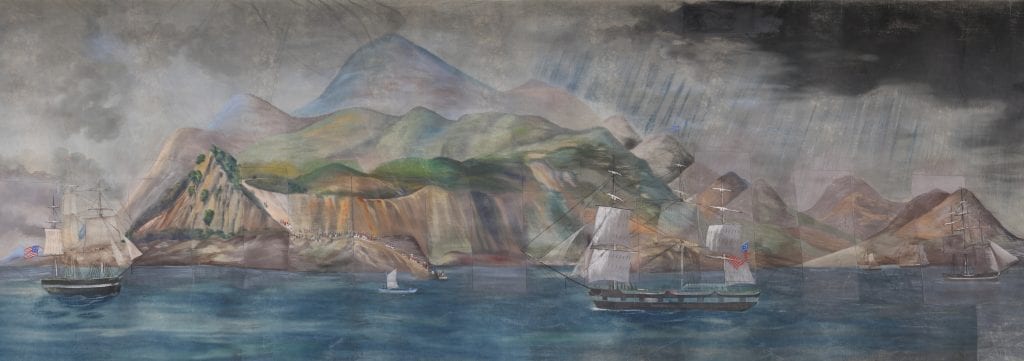
A Voyage Around the World demonstrates the remarkable geographical breadth of a real whaling journey. On this imaginary voyage you will begin with the Atlantic Islands of the Azores and Cape Verde, as you start with the many cultures encountered by whalemen. Then onto Brazil where the Portuguese influence is apparent and whaling was fruitful along the coast. Next, is the treacherous journey around South America’s Cape Horn where fierce winds, huge waves, and strong currents are the norm, but where the warm Pacific awaits. Each locale is vividly illustrated by large-scale reproductions of Benjamin Russell and Caleb Purrington’s 1849 Grand Panorama of a Whaling Voyage Round the World.
Our collection is overflowing with materials whalemen brought back from the many Pacific Islands including the lush Galapagos, Marquesas, and beyond to Fiji, and Samoa. By combining the Panorama images with art, artifacts and ethnographic objects representative of the cultures, as well as 19th century and early 20th century illustrations, sea charts, prints, logbooks, journals and account books, the curatorial staff, has created a powerful and evocative interpretation of the Portuguese experience in the Yankee whale fishery as it encountered these diverse communities.
The exhibition provides a wide sampling of these diverse cultures, but the focus is on regions including Brazil, California, Hawaii, and Alaska where the influence of Portuguese crew and their legacy becomes clear.
CAPE VERDEAN MARITIME EXHIBITION
Cape Verdean Gallery
Opened: July 5, 2011
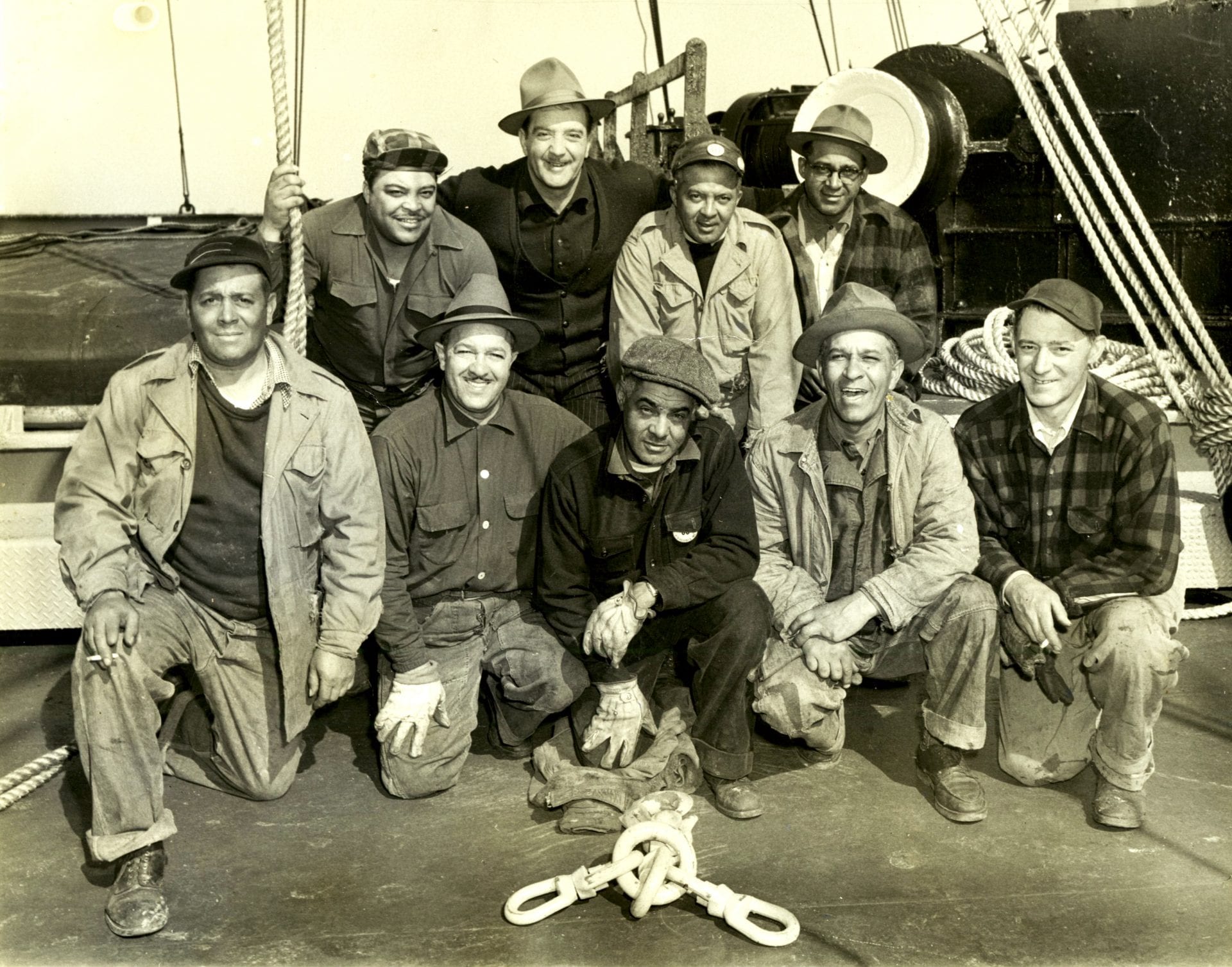
This exhibition explores the Republic of Cape Verde, its people, maritime history, connections to New England, and the legacies that continue to tie New Bedford and its culture to Cape Verde.
This exhibition captures the essence of the important connections between New Bedford and Cape Verde, the unique characteristics of Cape Verdean culture, and the special legacy of that culture and history here in New Bedford.
Trade between Cape Verde and New Bedford dates to the 1790s and earlier when New Bedford merchant vessels, bound for seal skins taken in the southern ocean, stopped in Cape Verde for supplies. From the middle of the 18th century the islands were also an important trade destination as the Isle of Sal provided salt, an important commodity, and American merchant vessels stopped there frequently to fill their holds with this valuable produce. Clothing and cloth were the most commonly traded American products.
Located off the westernmost cape of the continent of Africa, their geography also placed the islands in the direct path of whaling vessels sailing to the southern capes. As whalers and traders visited the islands for foodstuffs, water, and salt, the islanders themselves often joined the passing vessels. New Bedford whaling agents commonly instructed their masters to transship oil home from the “Cape de Verdes”. American whalers from New Bedford visited the islands beginning as early as the 1790s and began more regular trade in the early 19th century, mostly for fruit (principally oranges, bananas, coconuts, and watermelons) as well as hogs, chickens, and goats. Free Cape Verdean men sometimes joined the vessels as crew, often sought deliberately by whaling shipmasters eager to fill berths on their ships. The island men left their arid homeland; a homeland often plagued by disease and active volcanoes as well as a just horror of enforced military service, and “throwing themselves on the wings of fortune”, emigrated to New England on board the convenient vehicle of the passing whaler. As the men left, at the rate of as many as one hundred a year, the women were often left behind. The Secretary General of Cape Verde, reporting in 1874 on the status of women in the islands, noted that due to so many men leaving onboard visiting whalers, “there is a great disproportion between the male and female sexes”, and that many women sought passage to the U.S.A. on packet ships either in search of a husband or to join their husbands and family members.
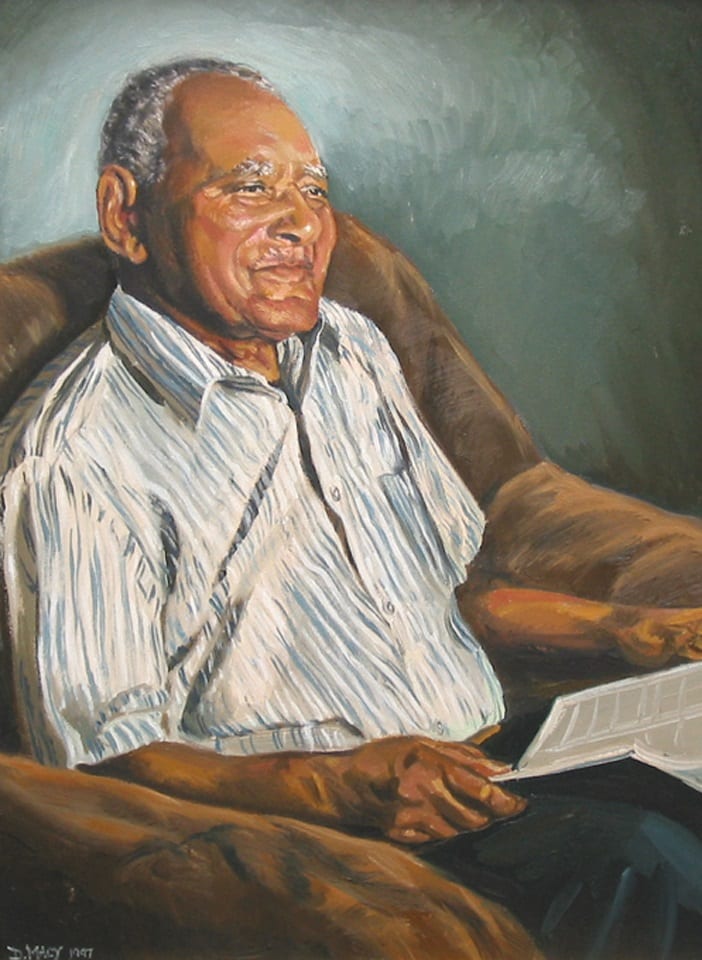
Once landed in New Bedford opportunities opened up for people willing to work. The city by the middle of the 19th century was a dynamic industrial maritime center. Its burgeoning growth supported a diverse demographic with peoples from all over the Atlantic world building new communities in the old colonial whaling port. These opportunities included shoreside labor, textile and cordage factories, agricultural work in the nearby cranberry and blueberry fields, and the opportunity to join a deep-sea vessel and apply innate skills and talents to work up through the ranks. The whale fishery provided Cape Verdeans various means to not only make a living but to excel. Not only Cape Verdean men benefited from the fishery. Immigrant women as well worked in the sail lofts of the city. Cape Verdean harpooners, of course, were legendary in the fishery. Men like João da Lomba and Bras Lopes, Theophilus Freitas and JosÂŽ Gomes were not only lead boatheaders, skilled whalemen, but officers onboard such famous vessels as the bark Sunbeam, the bark Wanderer, the brig Daisy and the bark Charles W. Morgan. These were the men who populated New Bedford's sperm whale fishery of the early 20th century.
Opportunity in New Bedford was certainly not limited to factories and whalers. As the 20th century went on and the ties between the islands and the port strengthened, entrepreneurs like Roy Teixeira, Henrique Mendes, Louis Lopes, Frank Lopes and Antonio Cardoza purchased, managed and owned packet ships like the Coriolanus, the Savoia, and the Arcturus.
These packet ships plied the Atlantic waters to and from the islands and New Bedford making the ports of Mindelo in São Vicente and Furna in Brava important points of embarkation for thousands of Cape Verdean immigrants to the United States. The majority settled in New England. Importantly, not only did Cape Verdeans settle in New Bedford, but between 1860 and 1965 41% of the packets trading between New England and the Islands were owned by Cape Verdeans.
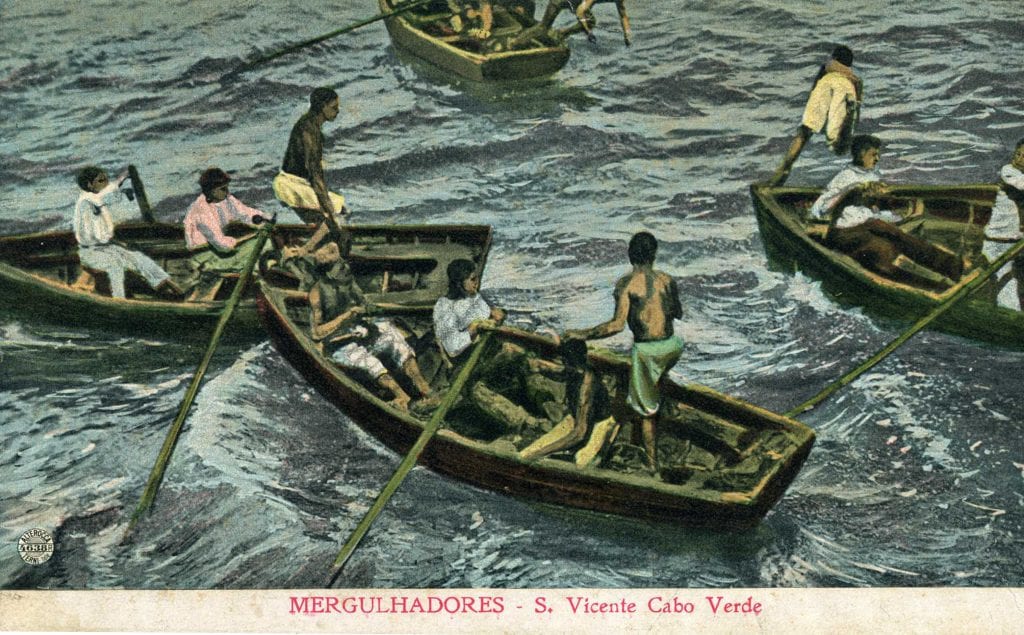
AZOREAN WHALEMAN GALLERY
Bourne Building main level and upper level
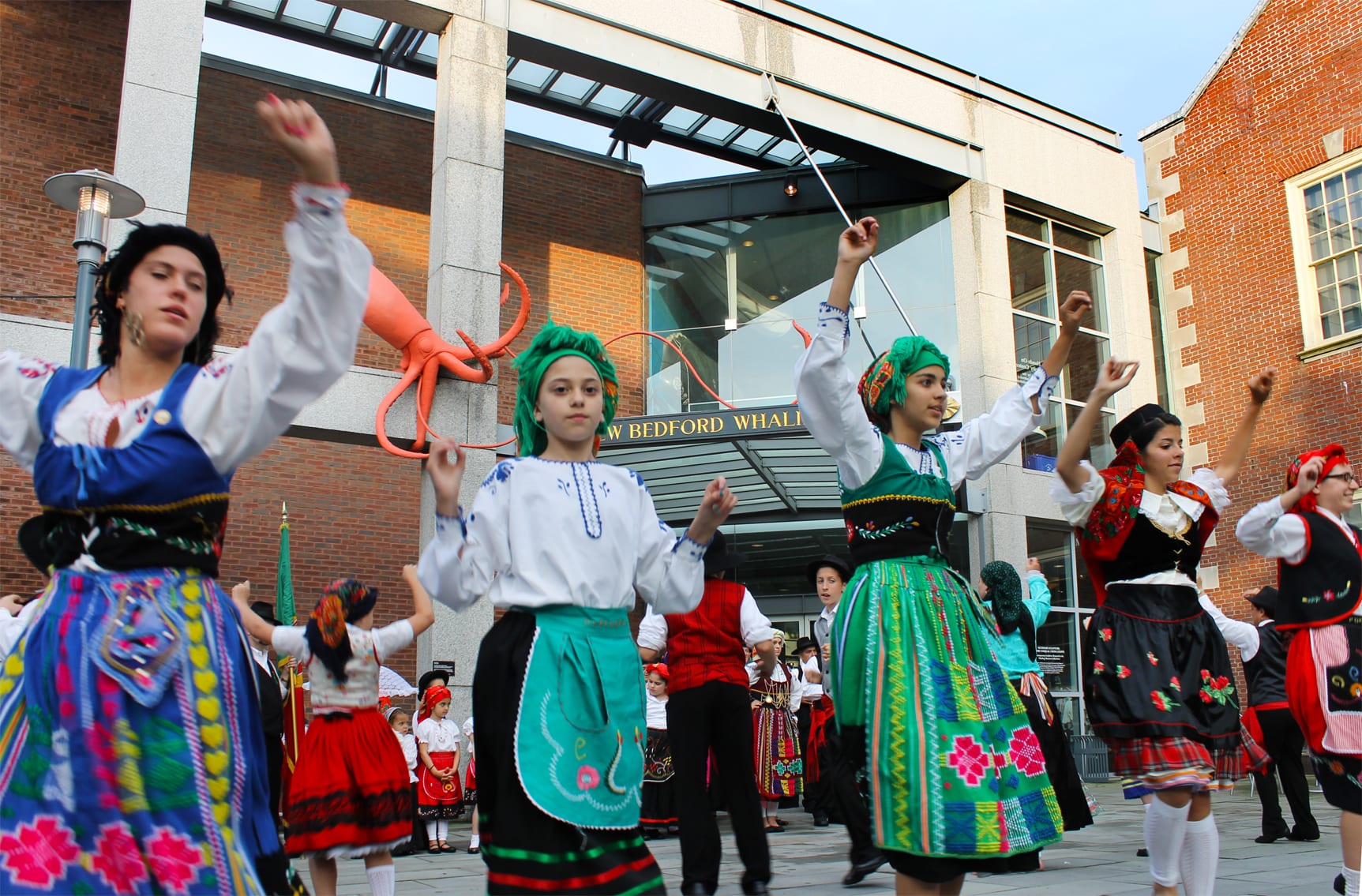
The Azorean Whaleman Gallery is the only permanent exhibition space in the United States that honors the Portuguese people and their significant contributions to this country’s maritime heritage.
It explores especially the Azorean impact in our region and the development of a vibrant Azorean community in New Bedford. The relationship between the Atlantic islands of the Azores and New Bedford, Massachusetts demonstrates the power of maritime culture to link peoples, ideas, traditions, and communities.
Since the United States’ earliest years, Yankee ships have visited the Azores’ shores. Prevailing westerly winds, the north-easterly flowing Gulf Stream, and a location in the middle of deep water sperm whale habitat made the islands perfect to serve the needs of whalers. Whaling ships took on both provisions and crew in the Azores, laying the foundation for a long and deep relationship between the islands and American whaling ports such as New Bedford.
The Portuguese in New Bedford continued to be tied closely to the sea, working on whale ships as both sailors and captains. They entered the business, as ship owners, textile manufactures, and entrepreneurs. Azorean Americans retained close ties to the islands while creating a unique, dynamic community in the United States.
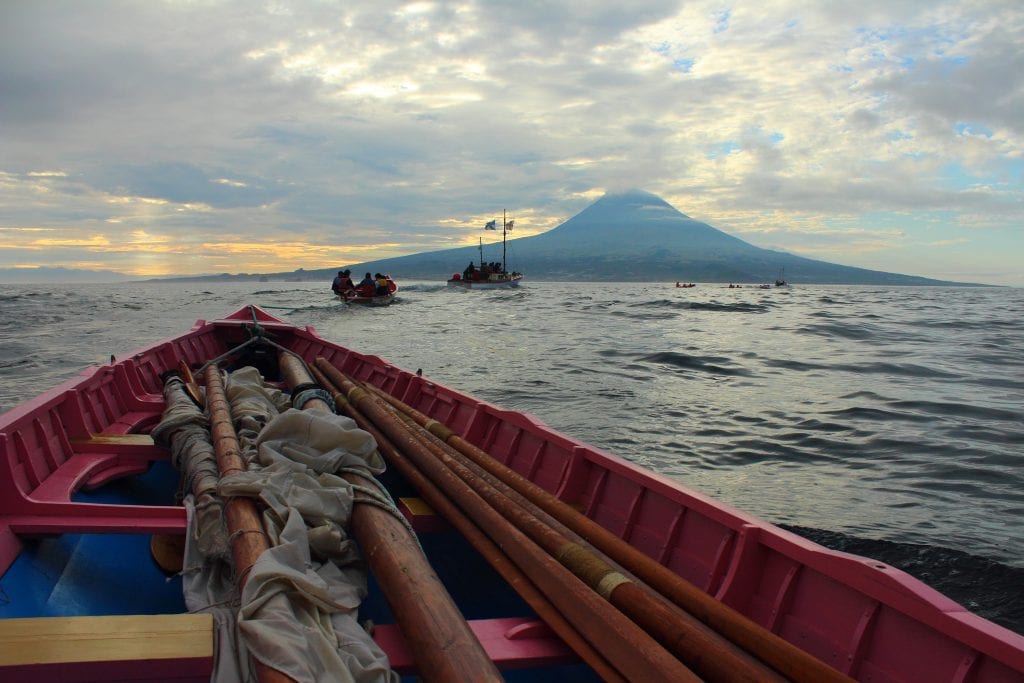
The Azorean Whaleman Gallery has recently been updated. Two major new elements are a large-scale model of an Azorean Whaleboat (view Azorean Whaleboat Model photographs on Flickr), and a recreated lookout (vigia).
POLAR BEARS (Ursus Maritimus) and the Arctic Imaginary
Center Street Gallery
Opened: December 12, 2022
Closed: May 7, 2023
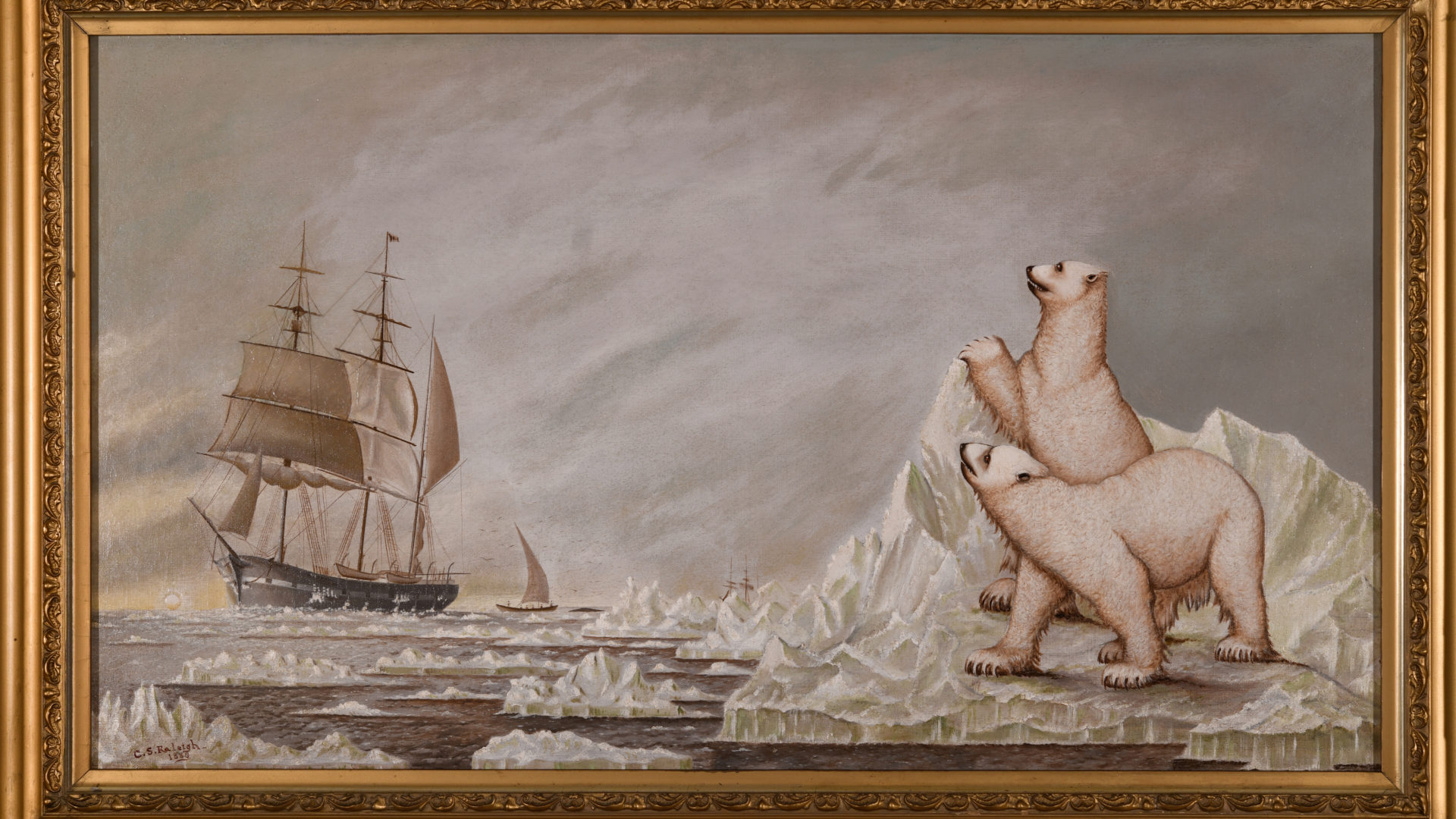
CAPTION: (above) Charles Sidney Raleigh (1831-1925). Intruders in the North, 1888. Oil on canvas, 17 x 29 ¾ in. (43.2 x 75.6 cm). Kendall Whaling Museum Collection, NBWM 2001.100.4328.
The polar bear (Ursus maritimus), also called white bear, sea bear, ice bear, or great white northern bear are found throughout the Arctic region. They travel long distances over vast desolate expanses, generally on drifting oceanic ice floes, searching for seals. The polar bear is the largest and most powerful carnivore on land, aside from one type of Grizzly. It is an extremely dangerous animal.
With global warming, it is also increasingly threatened.
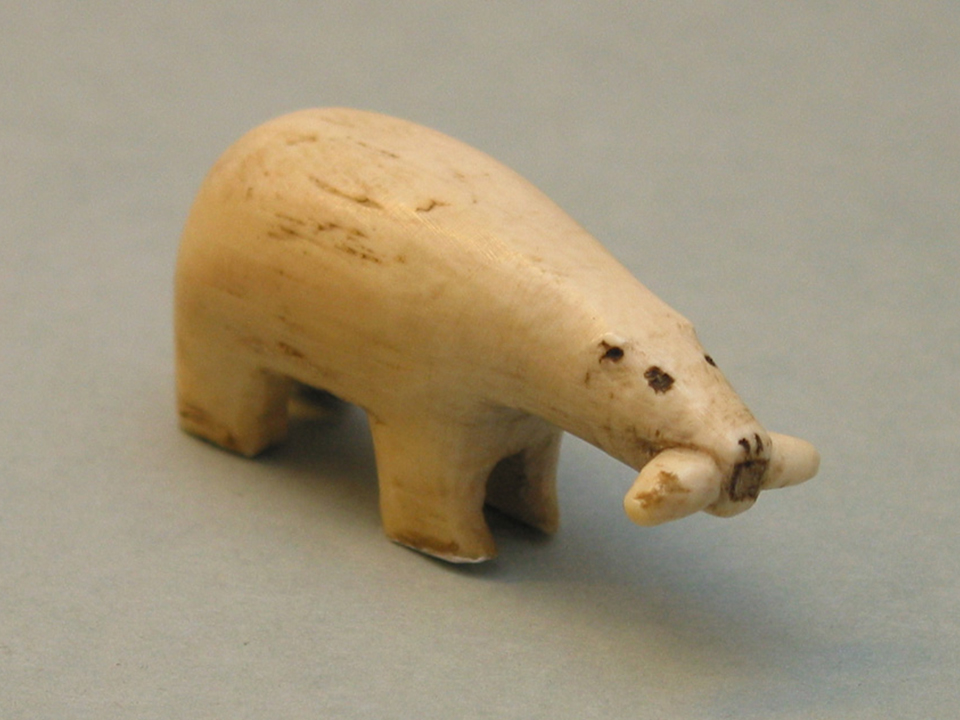
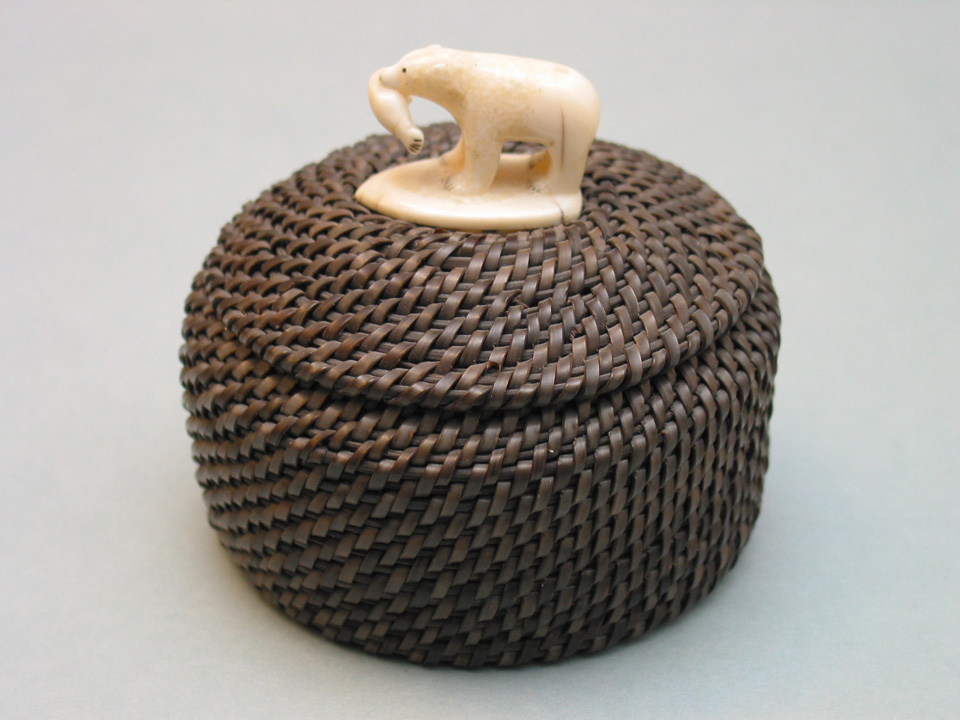
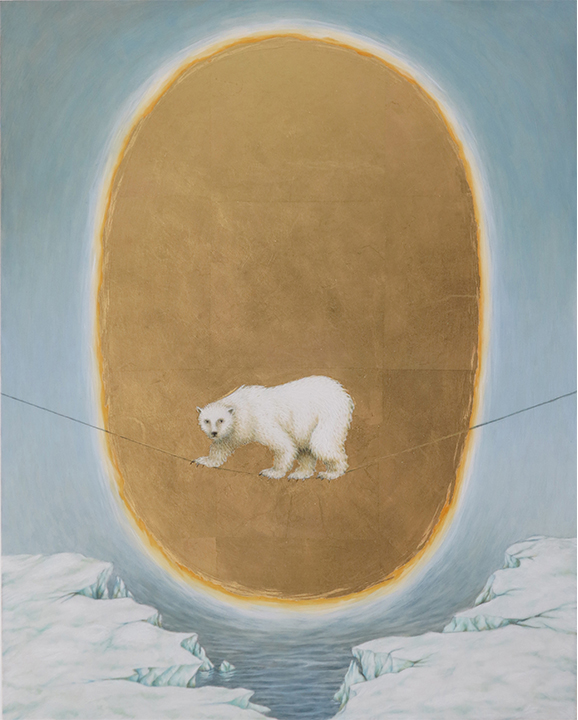
The New Bedford Whaling Museum holds a deep collection of hundreds of original artworks, photographs, carvings, and material culture depicting or made from polar bears. This exhibition showcases a cross-section of these extraordinary artworks in order to reveal and explore humankind’s fascination with and relationship towards this vaunted and elusive species.
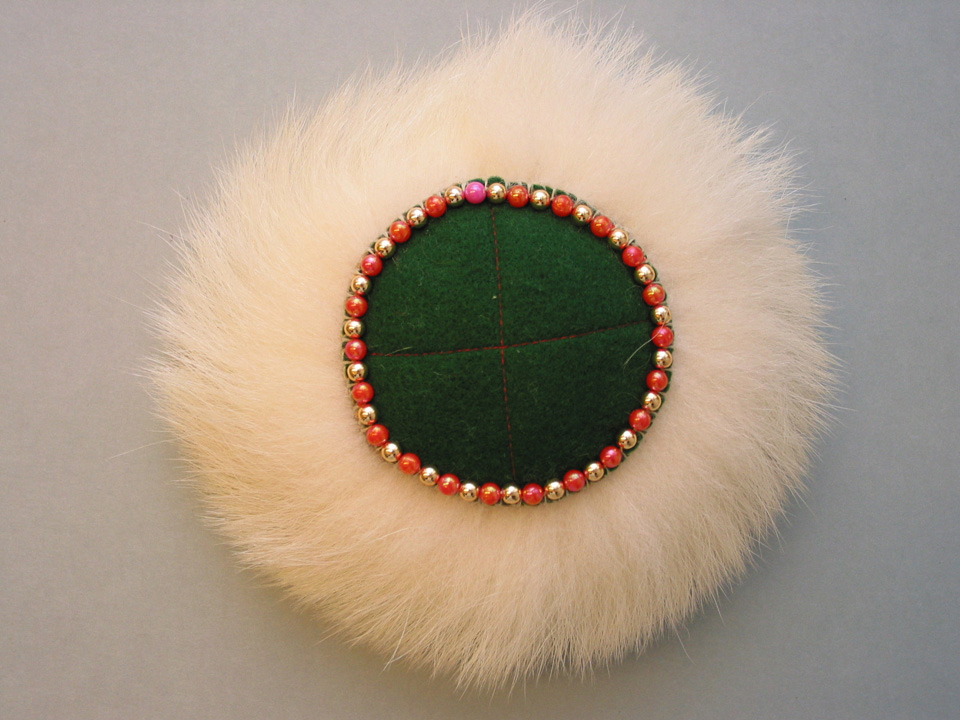
Pieces include British, German, Dutch, and American prints – mostly of the Greenland whale fishery, join Iñupiat carvings, baleen baskets, and pincushions trimmed with polar bear fur; historic photographs; Pairpoint glass, salt & pepper shakers, Delft tiles, and decorated dinner plates; and paintings – including Charles Sidney Raleigh’s “Intruders of the North,” which has recently been conserved. Finally, contemporary art adds to this rich tapestry, signaling the importance of polar bears to current culture and society. Such materials underscore the ways in which polar bears have been central subjects of historical artworks and material culture produced through the global interstices of arctic whaling, and illustrate how they continue to be dominant figures in the arctic imaginary.
Indeed, an exhibition on polar bears carries additional importance due to their threatened status. In 2020, WWF estimated that only 22,000 to 31,000 polar bears were living in the wild.
The International Union for Conservation of Nature (IUCN) classified the polar bear as a vulnerable species in 2006, and the U.S. government listed the polar bear as threatened in 2008. This is almost exclusively because of the ongoing effects of global warming, which rapidly reduces Arctic sea ice coverage. Population models predict increased rates of starvation for polar bears, as a result of longer ice-free seasons, a decline in mating success, since sea ice fragmentation could reduce encounter rates between males and females, and less nutrient rich foods. Given the compounding threats to the species, forecasts suggest that polar bear populations will decline by one-third by 2050. The exhibition spotlights the perilous position that polar bears find themselves in, thanks to human activity, and offers a space for conversation and dialogue regarding the future of the species.
Re/Framing the View: Nineteenth-Century American Landscapes
Wattles Family Gallery
Opened: October 28, 2022
Closed: May 14, 2023
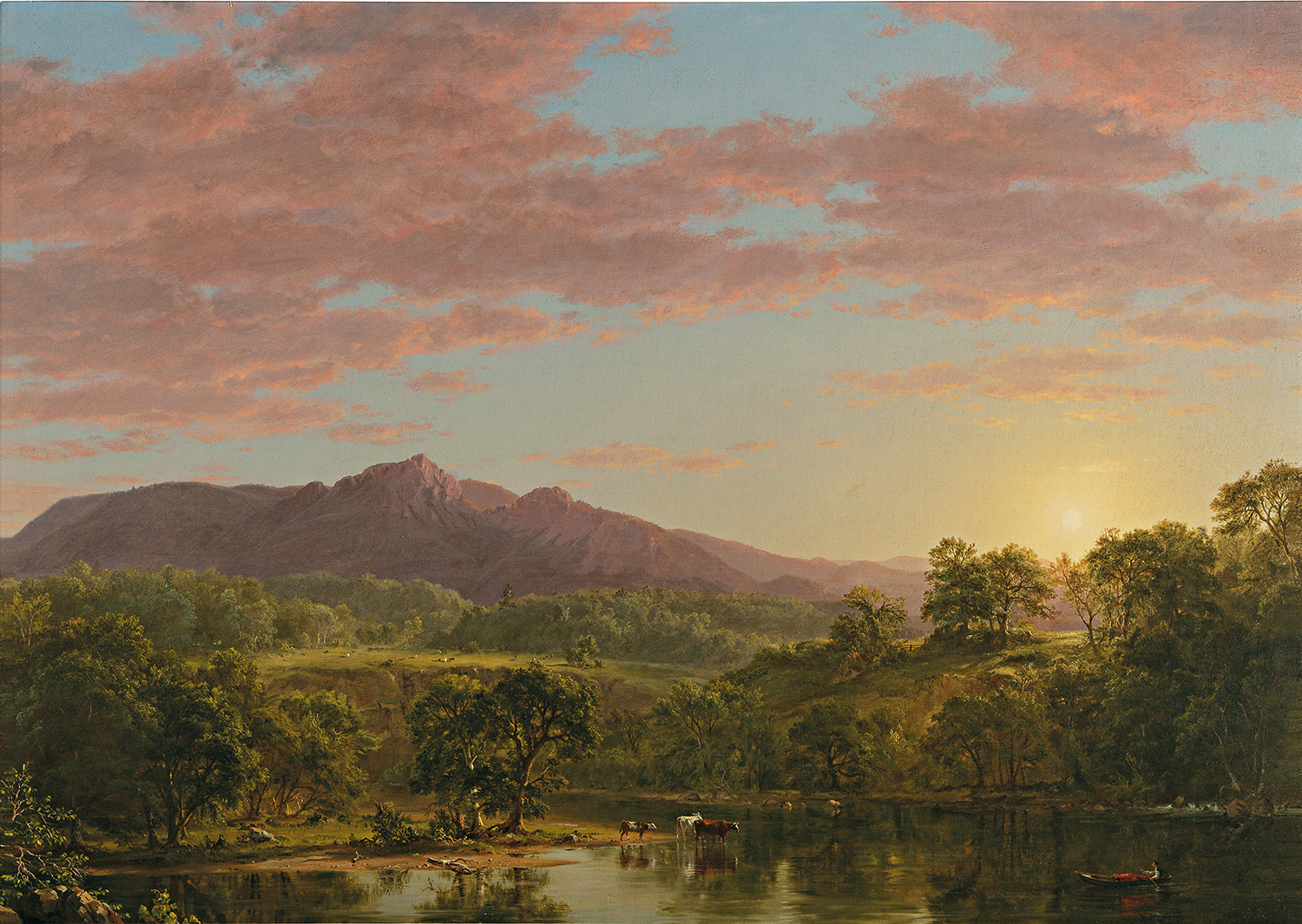
CAPTION: (above) Frederic Edwin Church (American, 1826-1900), New England Lake, c. 1854. Oil on canvas, 30 x 42 in. (76.2 x 106.7 cm). Douglas and Cynthia Crocker Collection. Image courtesy of Christie’s.
Re/Framing the view will be on view at the Minnesota Marine Art Museum from October 14, 2023 - August 4, 2024
Exhibition Programs
March 21st
Wampanoag Lifeways with David Weeden
April 8th
Cranberry Bog Walk
April 20th
Reading American Landscapes: Women and the American Scene with Naomi Slipp
April 22nd
Dunham’s Brook Conservation Area Walk
May 6th
Island Views Walk
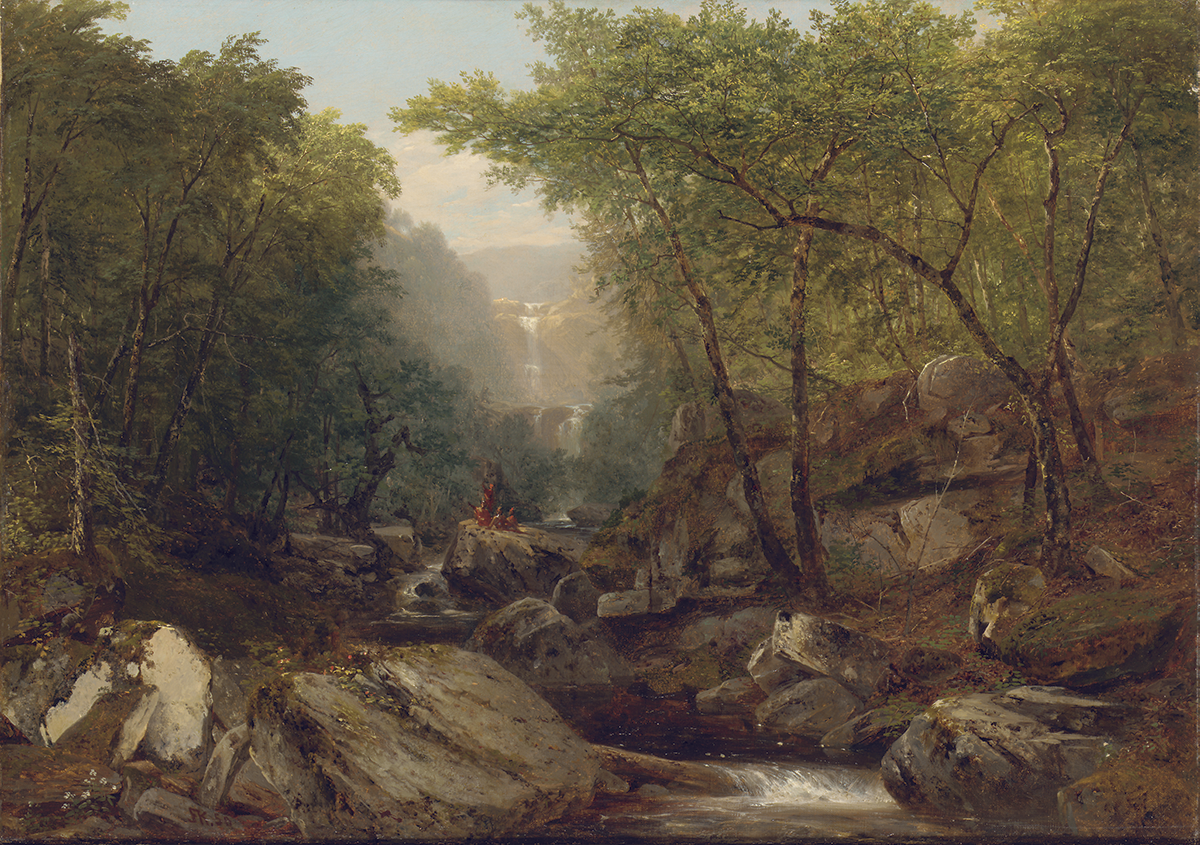
Nineteenth-century American artists are well known for their depictions of nature and the outdoors, for their commitment to creating a national “school” of painting, and for their documentation and idealization of scenery ranging from the imagined and pastoral to the dramatic and sublime.
Drawn from six regional private collections, the New Bedford Whaling Museum collection, and six strategic institutional loans, Re/Framing the View: Nineteenth-century American Landscapes includes works by Thomas Cole, the Peale family group, Thomas Eakins, William Bradford, John F. Kensett, Martin Johnson Heade, Frederic Edwin Church, Albert Bierstadt, Jasper Francis Cropsey, George Inness, Francis A. Silva, Sanford Robinson Gifford, and Edward Mitchell Bannister, among many others.
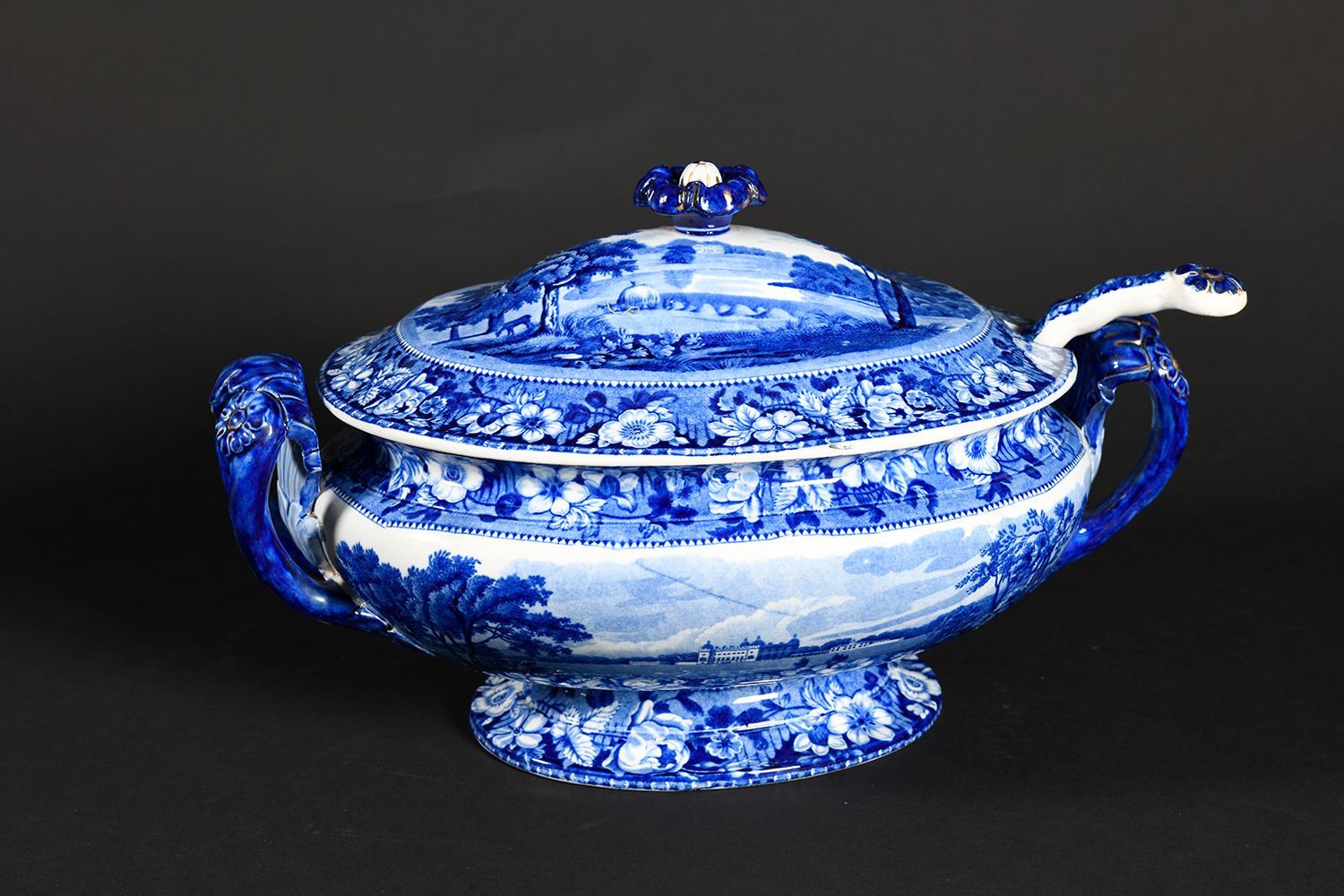
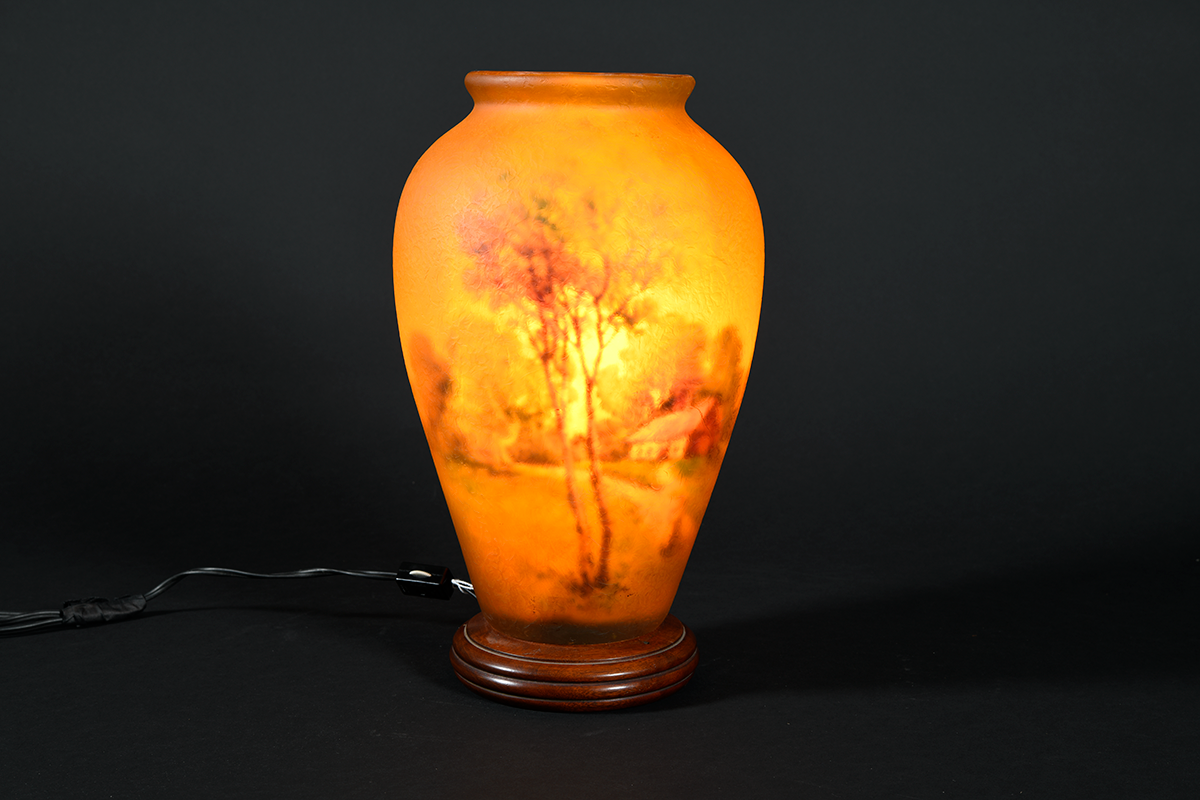
As this list suggests, the majority of US based nineteenth-century American landscape painters were men, and heading out into the wilderness to capture the scene was viewed as a masculine pursuit. A selection of objects – including china, nature studies in watercolor, and decorative arts – underscore the gendered aspects of American landscape painting by demonstrating where and how women participated in capturing American flora and fauna.
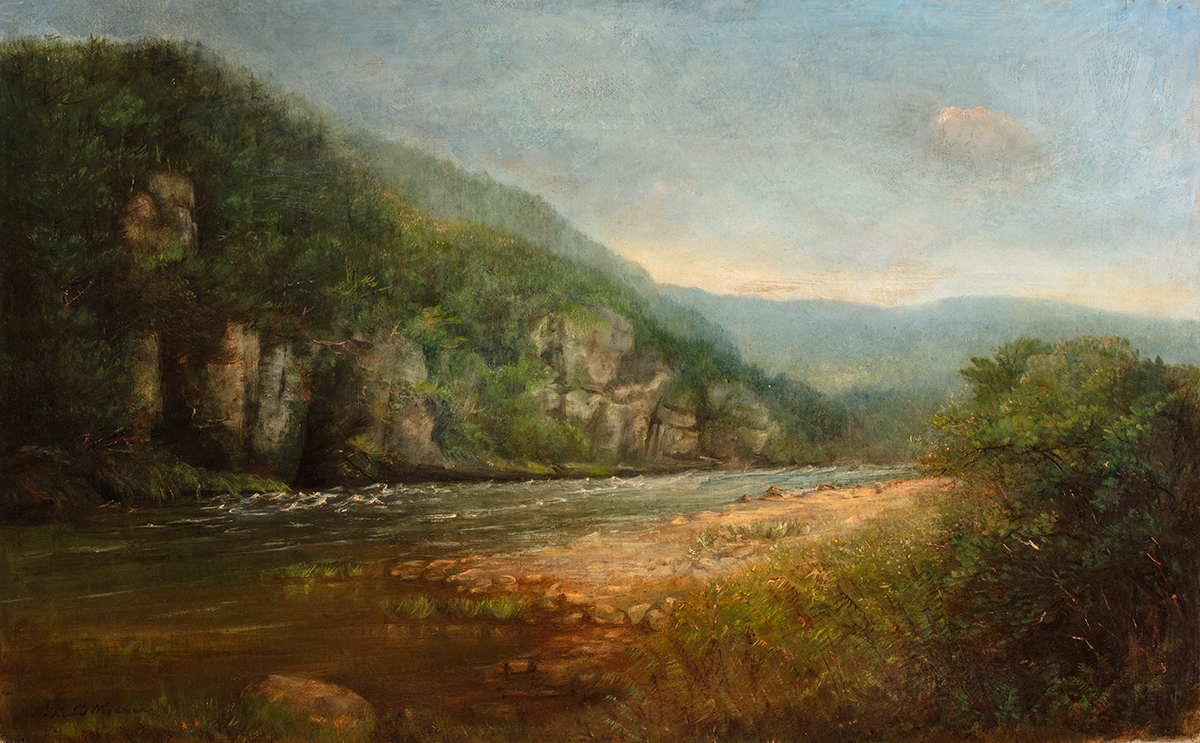
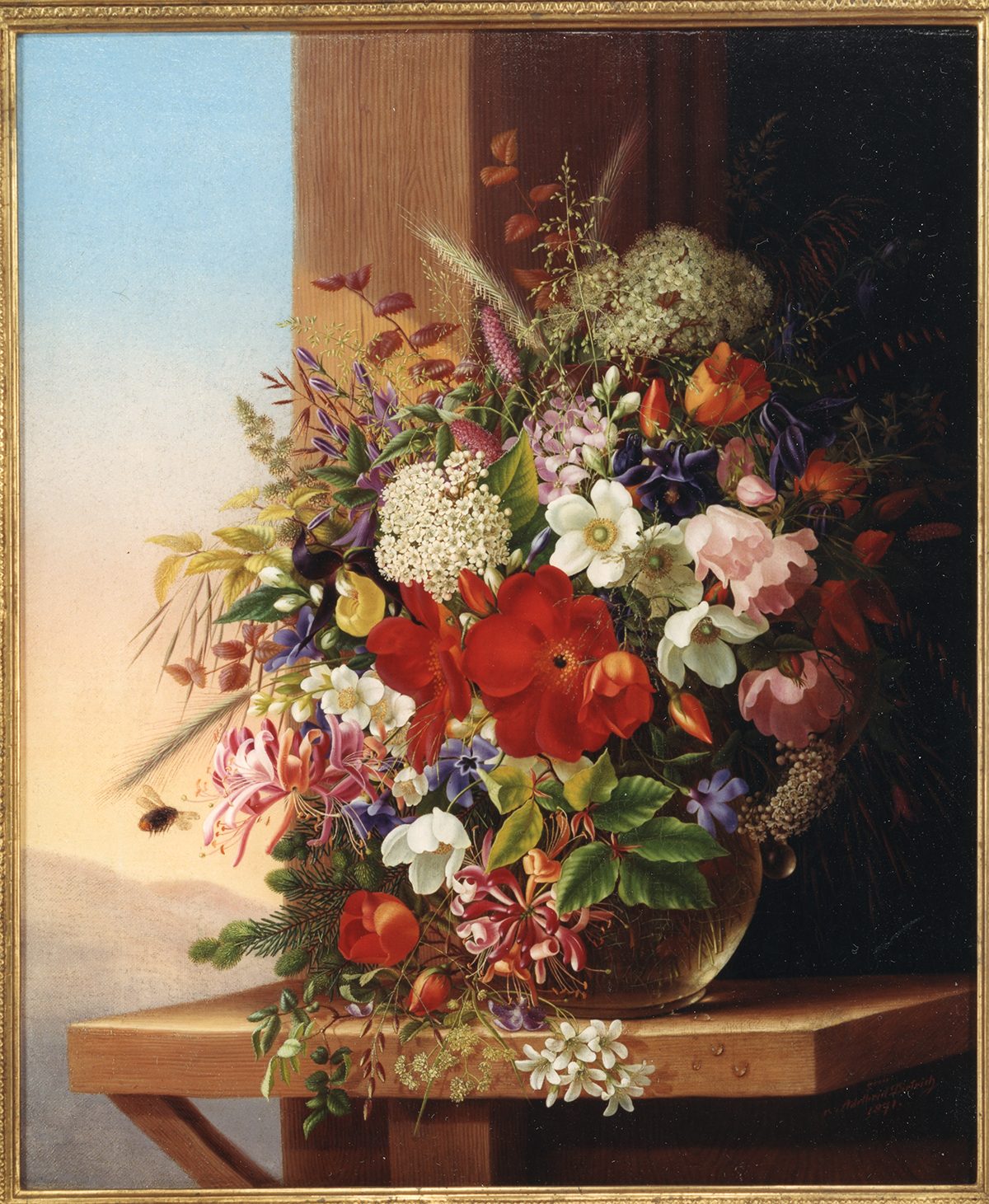
The realities of women’s opportunities in the arts are elaborated upon through paintings and prints by Fitz Henry Lane and Mary Mellen; Asher B. Durand and Lucy Maria Durand Woodman; Evelina Mount, Adelheid Dietrich, and Claude Raguet Hirst; and Mary Nimmo Moran and Ellen Day Hale.
While the exhibition celebrates the work of these artists, it also offers a layered interpretation of the cultural and historical meaning of such paintings. What such artists often failed to capture are the environmental conditions and social concerns that may underlie picturesque imagery.
The exhibition therefore aims to recast such orthodox American landscape paintings through a careful consideration of the roles women played in picturing nature – via still life, needlepoint, watercolor, and decorative arts, and the ways in which environmental degradation, Federal Native American removal policies, and racialization are either pictured or erased in American scenes.
Contemplating the paintings versus the subject matter, labels, interpretive texts, and strategic juxtapositions allows us to question what we “see” in the scene versus what we know was happening. Themes explored include the environmental and cultural violence underlying nineteenth-century American landscape painting, including manifest destiny, settler colonialism, and Native removal; material extraction and industrial expansion; agricultural development and fisheries; and global exploration and imperialist projects.
By interrogating the place of gender, race and ethnicity, as well as environment and ecology, we re/frame the view and stage meaningful conversations about historical and contemporary issues and events.
The exhibition promises to be an exciting and timely invitation to view paintings held in private hands and usually hung behind closed doors – and explore the many meanings of the American landscape, both historically to nineteenth-century viewers and today for twenty-first century audiences.
This landmark exhibition and major publication have been made possible by funding from:
The William M. Wood Foundation, Cynthia & Douglas Crocker II, Victoria & David Croll, KAM Appliances, Louis Ricciardi & Elizabeth Soares,
Mary Jean & William Blasdale, Sarah Jackson, Ann & Lloyd Macdonald, Anonymous Donor (2), Individual Contributors
Program partners include: Sippican Lands Trust; Westport Land Trust; Dartmouth Natural Resources Trust; and the Mashpee Wampanoag Tribe
Henry Horenstein
Upper Level Galleries
Opened: June 9, 2022
Closed: December 18, 2022
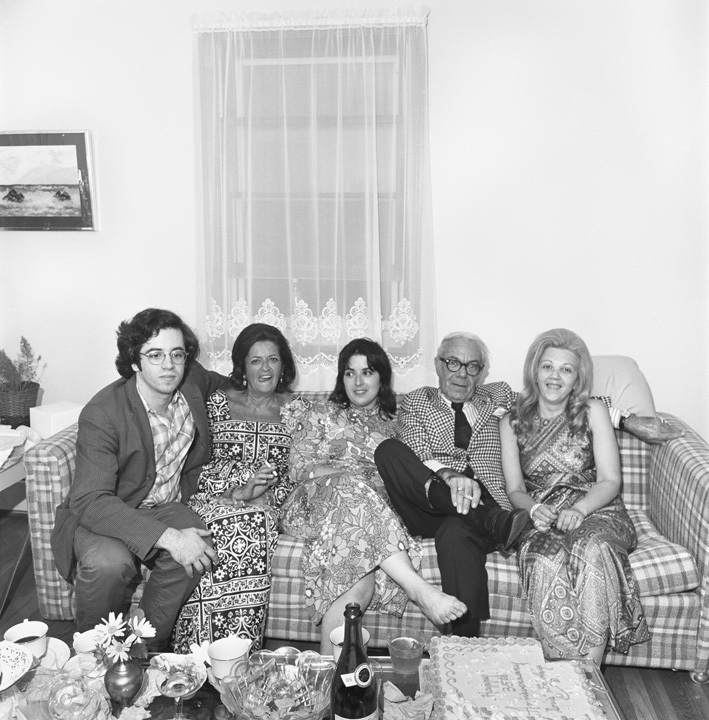
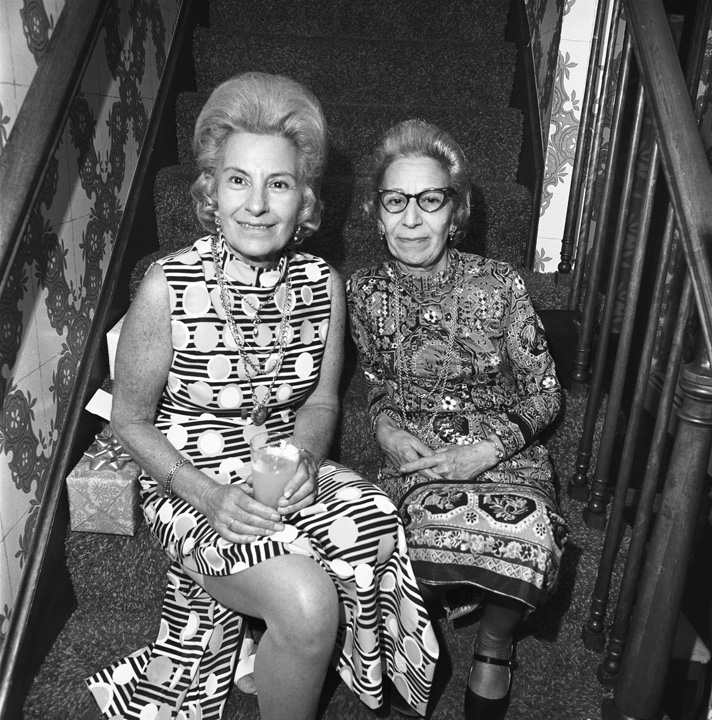
CAPTION: (above) Self Portrait with Family, Dartmouth, 1972
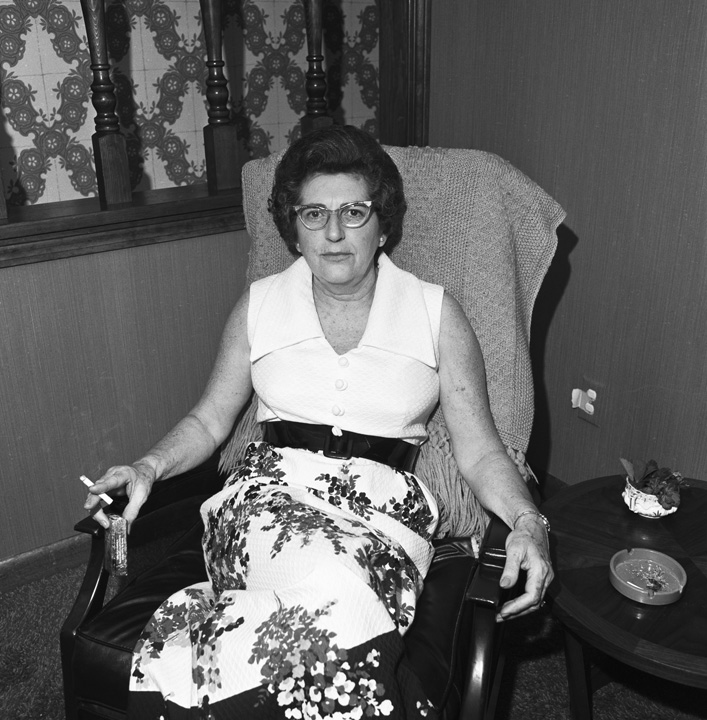
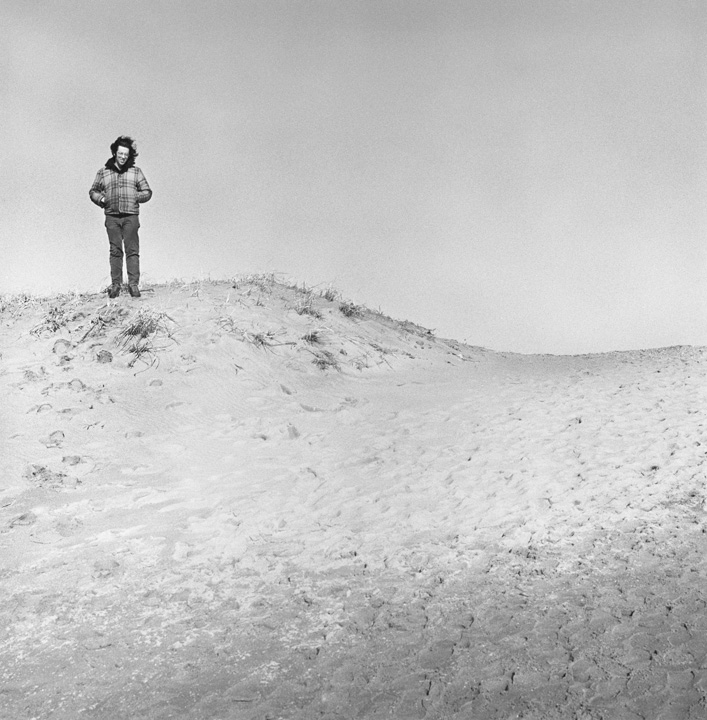
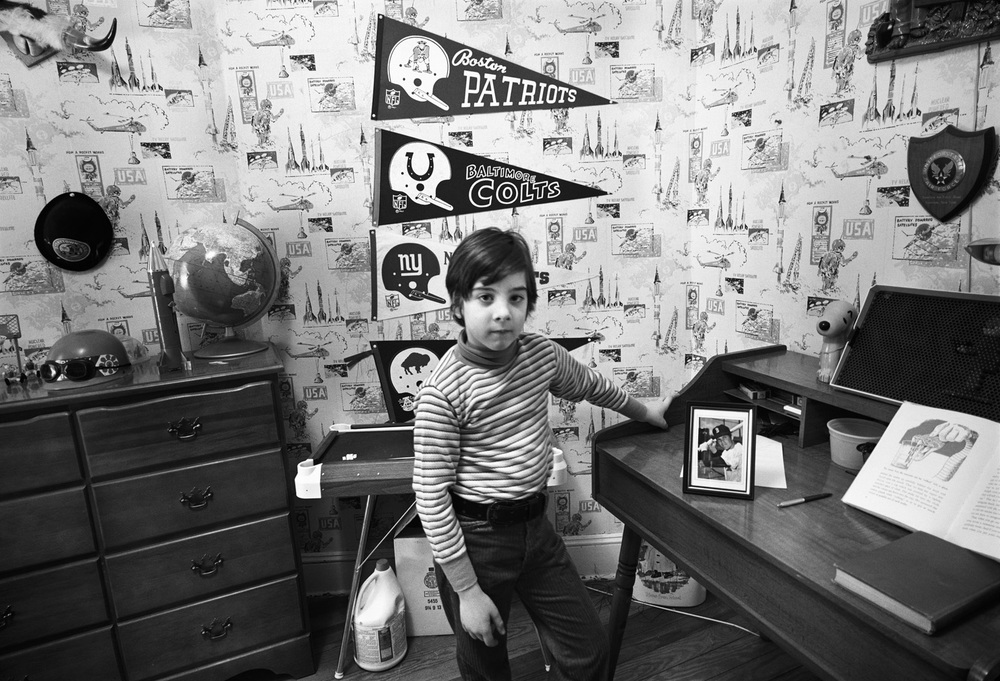
Horenstein characterizes this series as “a portrait of a unique place and time. A history.”
Between 1970-77, Henry Horenstein took medium format photographs of his family, neighbors and friends – first, in the SouthCoast areas of New Bedford and Dartmouth and, later, in Greater Boston, where his parents moved. Organized as a component of the NBWM exhibition and oral history initiative, Common Ground: Community Stories, “Close Relations” presents an intimate and photographically compelling look at life in the SouthCoast in the early 1970s. Horenstein characterizes this series as “a portrait of a unique place and time. A history.”
In this body of work, Horenstein adopts a snapshot aesthetic that was in widespread use by artists of the contemporaneous “New Documents Movement,” including Lee Friedlander, Diane Arbus, and Garry Winogrand, among many others. As MoMA curator John Szarkowski explained in 1967, this generation of photographers “redirected the technique and aesthetic of documentary photography to more personal ends. Their aim has been not to reform life but to know it.” Szarkowski would later describe how photography fell into two camps: mirrors and windows, writing: “The distance between them is to be measured not in terms of the relative force or originality of their work, but in terms of their conceptions of what a photograph is: is it a mirror, reflecting a portrait of the artist who made it, or a window, through which one might better know the world?” Horenstein’s works are both: mirrors, which reflect a portrait of the artist in this era of his life, but also of a community, a time, and a place, and as windows allowing visitors an intimate glimpse into this period.
About the Artist
New Bedford native, Henry Horenstein, is a professional photographer, filmmaker, and teacher, who studied at RISD in the 1970s under Harry Callahan, Aaron Siskind, and Minor White. A longtime professor of photography at RISD, Horenstein’s works are held in major museum collections and he is also the author of over 30 books.
William Shattuck: Reveries
Big Braitmayer Gallery
Opened: June 3, 2022
Closed: January 1, 2023
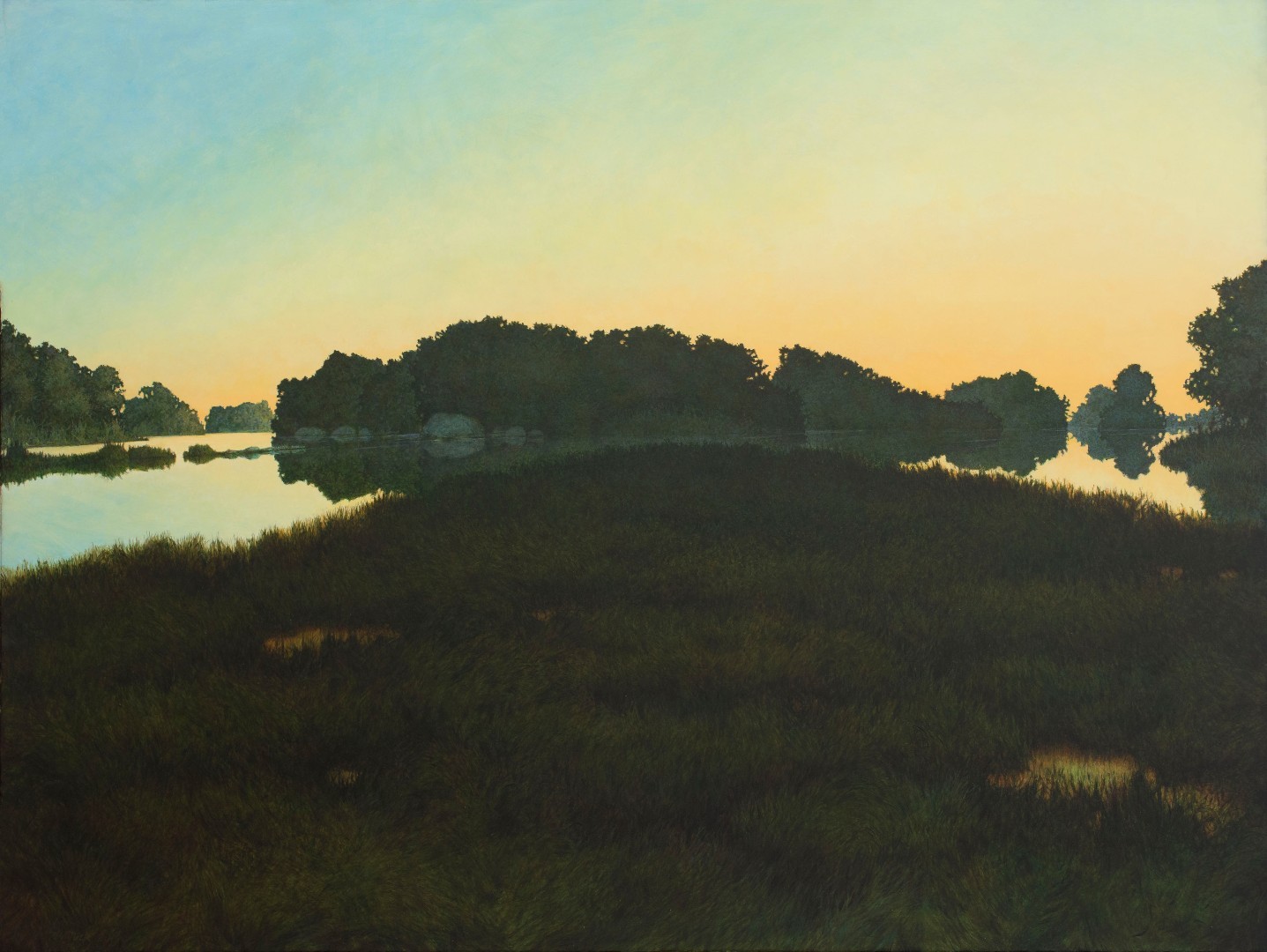
CAPTION: (above) “Moment," by Bill Shattuck
Exhibition Opening and Reception
Thursday, June 2
5:00 - 6:00pm
Join artist, William Shattuck, and New Bedford Whaling Museum Chief Curator, Naomi Slipp, as they discuss Shattuck's exhibition, Reveries. Meet the artist and enjoy light refreshments.
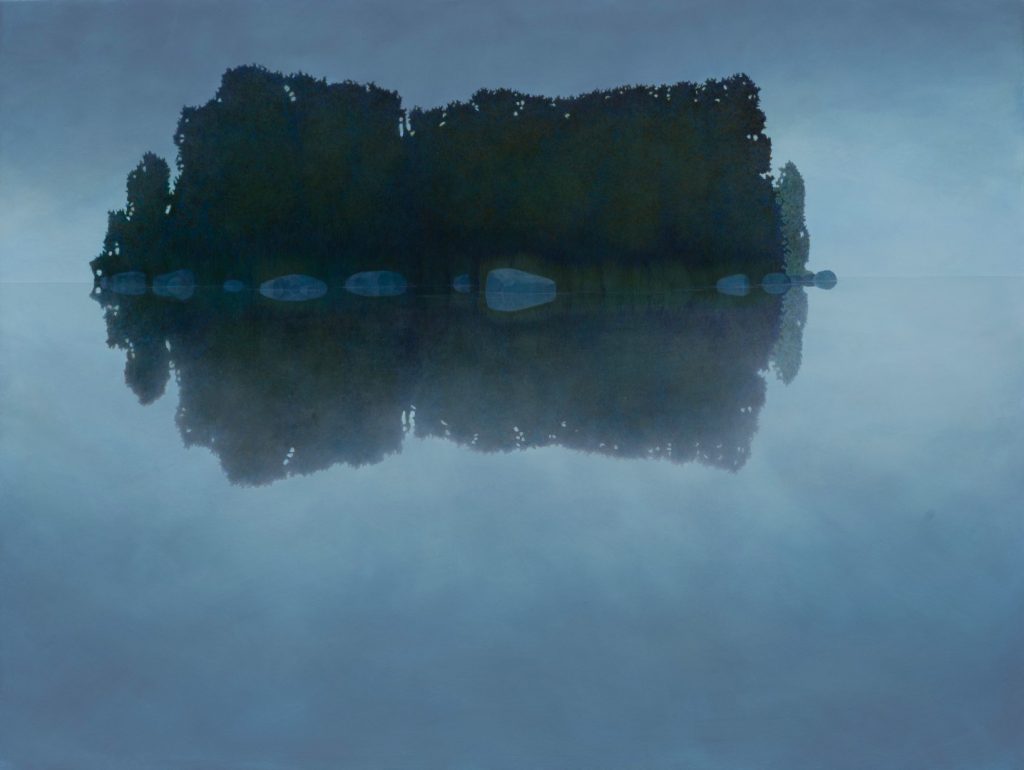
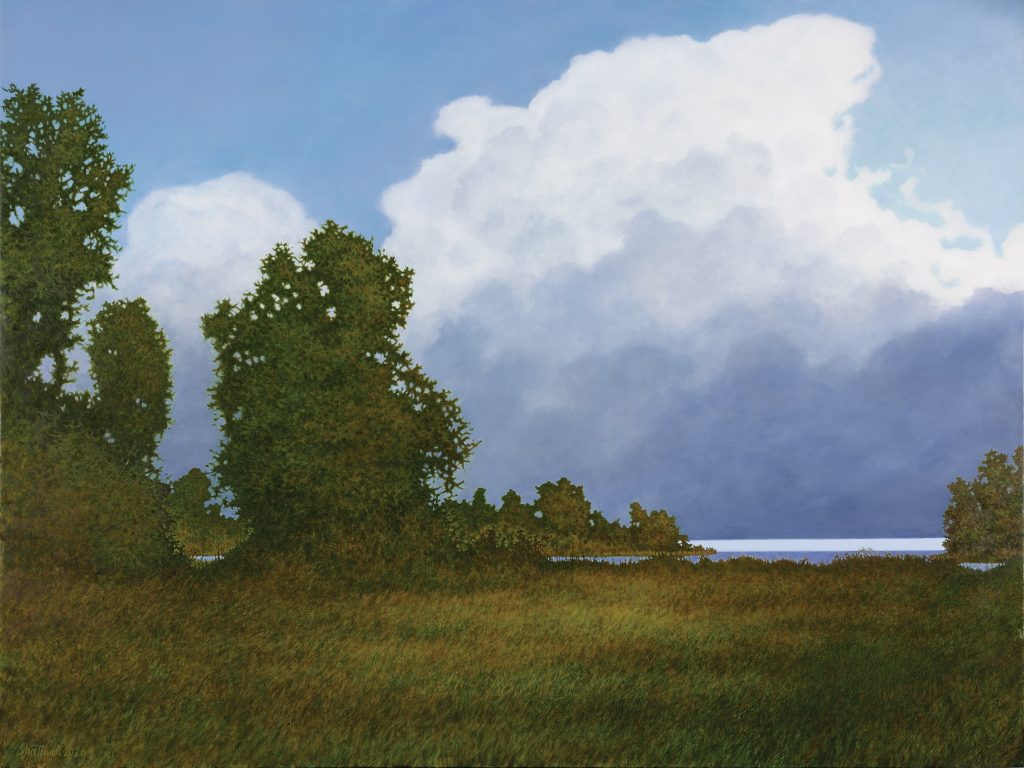
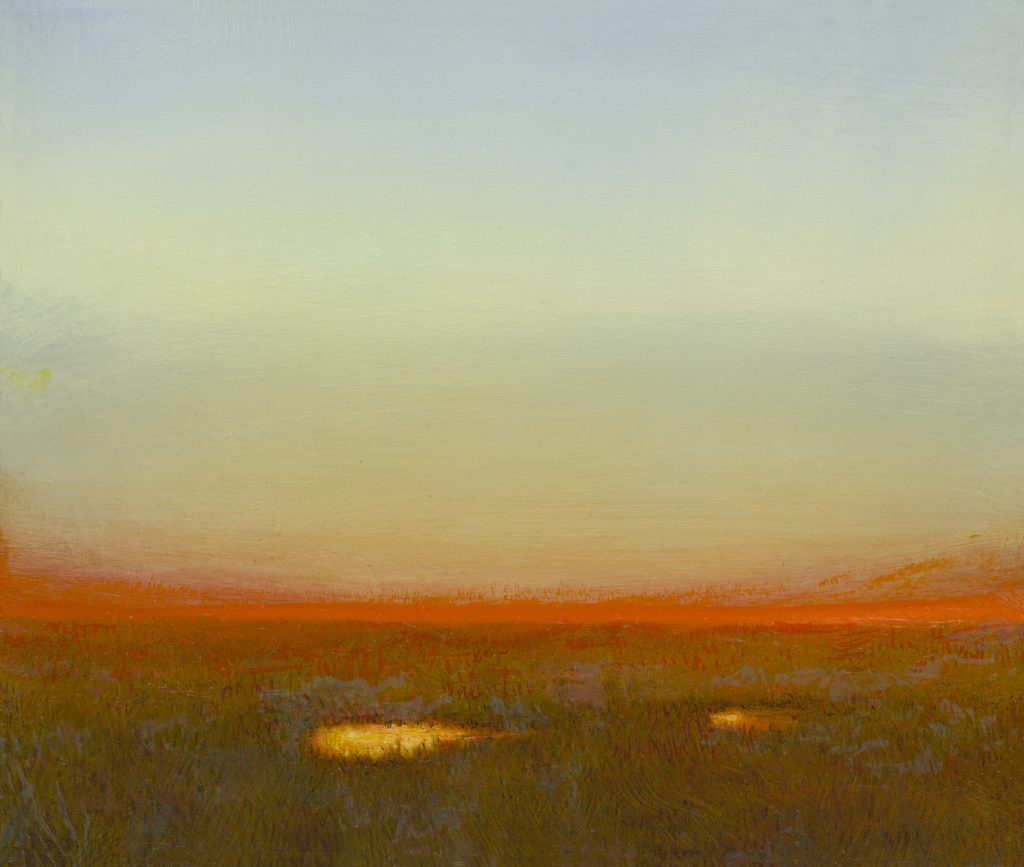
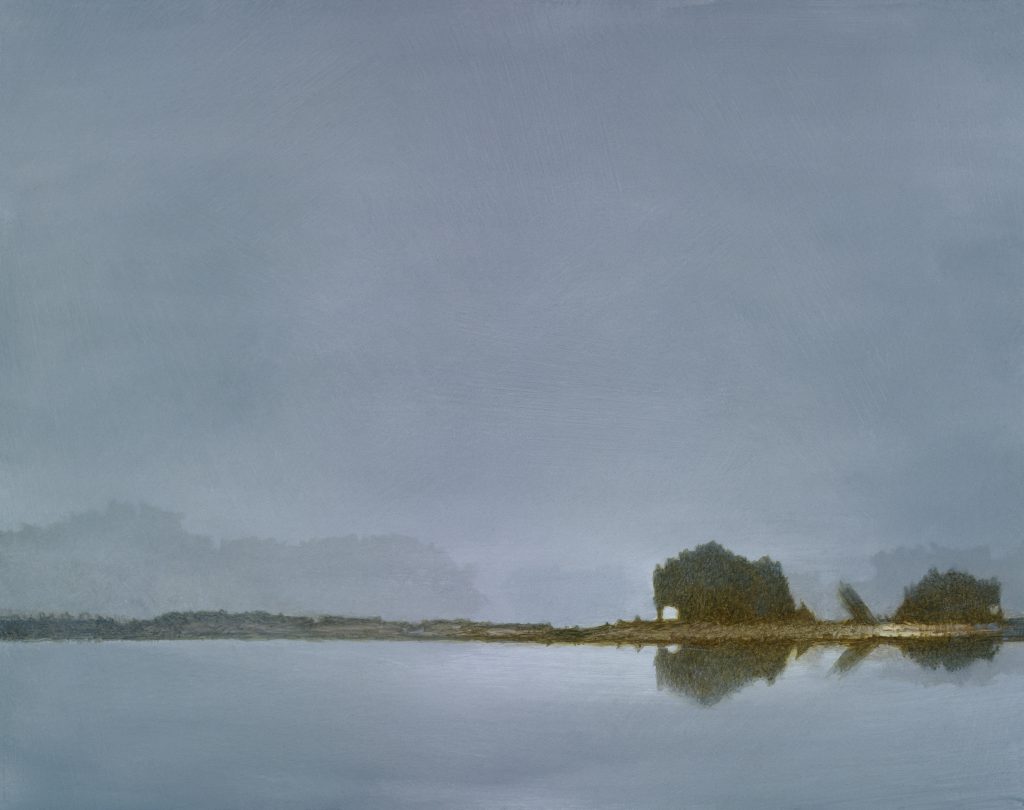
“Drawn in by color, composition and light, I find I’m also inspired just as easily by the temperature, the character of the air and atmosphere in the moment. I am not a Plein Air painter by any means, but I do spend a good deal of time walking through the fields, woods and marshes along this shoreline, noting the beauty and interplay between land, water and sky. I’ll sometimes make a line drawing with color notes, then eventually execute a finished piece in my studio.” -- Shattuck
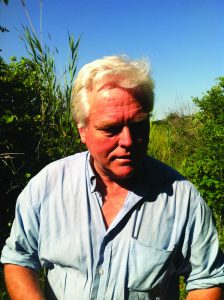
William Shattuck lives in Southeastern Massachusetts. His paintings reflect a fascination with the tidal marshes, estuaries and woodlands along that coastline. Having moved there in 1980 from New York, he has appreciated the changing patterns of light and weather throughout different seasons and times of day.
This exhibition features Shattuck’s evocative, moody landscape paintings. Shattuck employs careful brushwork and layered glazes to capture early morning light, haze on the marsh, or eerie glow of twilight on darkened tree trunks. His works evoke the attention to detail of the French Barbizon school, the impressionist studies of light and time by Claude Monet, and the luminescent glow of Maxfield Parrish.
These large-scale oil on canvas paintings render the scenery around his Dartmouth home as if attendant to verisimilitude. In fact, each landscape is a fiction, a fantasy construct produced by the artist from memory, a pastiche of mood, light, and atmosphere. They are quiet, contemplative, and introspective paintings, that marshal a kind of hushed reverence from visitors.
Large in scale, Shattuck's artwork draws viewers into their detail and scenery, and invite them to bask in the stillness of a transient moment captured in time.
 About the Artist
William Shattuck, born in 1950, was raised in the New York City area. Primarily self taught, he eventually studied painting. printing and drawing at The Art Students League and The School for Visual Arts, both in Manhattan. At an early age, he visited his uncle, Peter Shattuck in the mid 1950s at his studio inn Greenwich Village, on Thompson Street. He was his father's youngest brother, a painter, and inspiration.
"I thought, adults are actually allowed to do this? Painting and drawing?" -- Shattuck
From 1973 to 1980 he worked in New York City - first for The New York Daily News, then as a commercial artist for an advertising firm and as a freelance illustrator. It was during this time that he became fascinated with translating the written word into visual language.
Upon moving to Southeastern Massachusetts in 1980, where his wife Dorothy grew up, he began painting the beautiful wet lands and marshes of the area while still pursuing his fascination with more narrative work, primarily through highly rendered charcoal drawings.
Shattuck taught for two years at The College for Visual Arts at The University of Massachusetts Dartmouth. In 1993, he and writer, Deborah Kovacs, collaborated on the children's book, "Moonlight On The River," a story about his two sons published by Viking Penguin Books.
His work can be found in private and museum collections, including The DeCordova Museum in Lincoln, MA, as well as the print and drawing collection of The Wiggins Gallery at The Boston Public Library, and corporate collections.